Ever wonder if your marriage can feel close and alive again—even after disappointment, disconnection, or broken trust?
Rebuilding Us is a Christian marriage podcast for couples who want more than surface-level advice. Hosted by speaker, author, and relationship expert Dana Che, each episode brings together biblical truth, honest conversations, practical relationship tools, real hope—with enough humor to make the hard conversations a little easier.
Whether you’re struggling with communication, recurring conflict, emotional distance, rebuilding trust, infidelity, or simply wanting a deeper connection with your spouse, Rebuilding Us will help you understand what’s really happening beneath the surface—and what it takes to move forward.
Through solo teaching, real-life stories, and conversations with insightful guests, Dana brings warmth, wisdom, candor, and humor to the conversations couples are often afraid—or unsure how—to have.
You’ll learn how to move from conflict to connection, rebuild trust, strengthen intimacy, and grow together through every season of marriage.
Because relationships can get messy. Trust can be broken. Connection can fade.
But broken doesn’t have to mean beyond repair. We’re rebuilding what life tried to break.
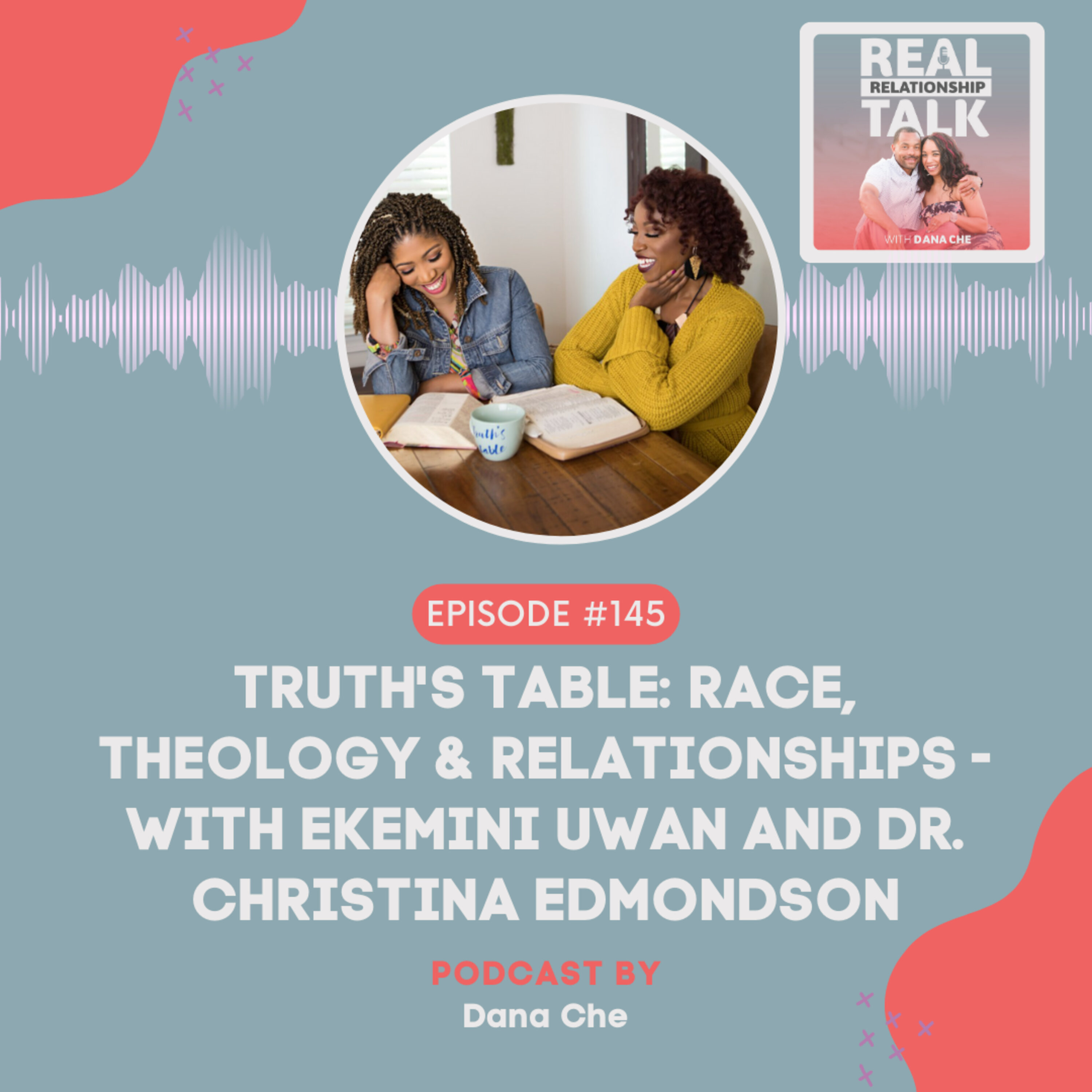
Truth’s Table: Race, Theology & Relationships - with Ekemini Uwan and Dr. Christina Edmonson Today we are so blessed to have with two midwives of Culture for Grace and Truth, Ekemini Uwan and Dr. Christina Edmonson, of the highly acclaimed and award-winning Truth’s Table Podcast. I have been listening to their podcast for a couple of years and when Hannah, our podcast editor, reached out to tell me we were going to have them on the show, I could hardly contain my excitement. Truths’ Table is a go-to podcast in the black, Christian community, and has even been featured on Grammy Award Winning Hip-Hop Artist, Lecrae’s album, All Things Work Together. Ekemini Uwan Ekemini and Christina share their much-needed perspectives on politics, race, culture, entertainment, and gender filtered through an accessible yet robust Christian theological framework. Ekemini is a public theologian and also a contributing writer for Hallmark Mahogany (which is my favorite brand of greeting cards by the way). Christianity Today named her among "10 New or Lesser-Known Female Theologians Worth Knowing. Ekemini has appeared on MSNBC, and her insights are quoted by NPR, CNN, The New York Times, The Washington Post, and The New Yorker among other publications. Ekemini is also single and shares her perspective on today’s show on living single. She writes a chapter in the book called Hidden in Plain Sight: A Single Black Woman’s Manifesto. Dr. Christina Edmonson Christina holds a PhD in Counseling Psychology, a Masters degree in Family Therapy, and a Bachelor’s degree in Sociology. She speaks and writes on leadership development, anti-racism, and mental health issues. Christina has been married for over two decades and shares some powerful truths about mutual submission and healthy marriage. Truths’ Table podcast, featured on Grammy Award Winning Hip-Hop Artist, Lecrae’s album, All Things Work Together and their book called Truth’s Table: Black Women’s Musings on Life, Love, and Liberation has been nominated for the 54th NAACP Image Awards! Get excited!! Let’s welcome the show Ekemini Oowan and Dr. Christina Edmonson. Relationships are complex as it is, but adding race to the mix can make things even more challenging. The ladies offer insights that could help us all navigate these relationships more thoughtfully. Colorism and Light-Skinned Privilege One of the most important themes that emerged in the episode was a conversation about colorism in the black community and the importance of acknowledging privilege. Christina spoke candidly about how the lighter-skinned privilege she experiences can lead to resentment and confusion in relationships with other Black women. She also recognized how societal and historical factors have contributed to her privilege, saying "It's hard to recognize my privilege because it feels like denying the pain and experiences of other people.” Dr. Christina Edmondson emphasized that it's important to reflect on our own privileges and how they impact our relationships. For example, she spoke about how Scripture has historically been interpreted primarily by men, and how this can have implications for how women are perceived in relationships. Men often hold positions of power in society and the church, and their hermeneutic might be self-serving in order to gain validation they don't get elsewhere. This conversation around privilege intersects with the topic of colorism, or the bias against people with darker skin tones, which can be especially damaging in relationships between Black men and women. Society has conditioned us to see lighter skin as warmer and kinder, and darker skin as mean and cold. Ekemini spoke about her own experience with colorism, where people have made negative assumptions about her personality or intellect based on the tone of her skin. ALSO LISTEN TO: Race Conversations 101: How to Have Civil, Compassionate, & Courageous Conversations About Race Submission in Marriage While the conversation around race and privilege can feel heavy, we also offered some practical insights that could help people to navigate relationships more effectively. Since this is a marriage podcast, we had to discuss the concept of submission in relationships. Christina spoke about the fear or discomfort some women may have around the idea of submission, but pointed out that mutual submission in a couple's relationship assumes equity, unlike a hierarchical relationship between a child and parent. Submission in a couple's relationship requires both partners to lay down preferences, and is ultimately an expression of love. Dating Challenges in the Social Media Age The episode also touched on the challenges of dating, particularly in the age of social media and dating apps. Ekemini spoke candidly about her own experiences, and how she prefers to meet people through mutual connections. However, due to the constraints of modern dating, she also uses dating apps. She is looking for someone who loves God, has good ethics, is kind, and aware of their issues and is willing to grow together. Past Trauma and Relationships Another major topic of the discussion was how past trauma can impact marriages and relationships. The guest speakers emphasized the importance of self-reflection and facing mirrors that show our flaws. Unacknowledged trauma can seep into marriages and cause pain and issues, which is why it's important to name and reconcile any painful experiences. Authentic Conversations about Race At its core, this podcast episode offers a testament to the power of authentic conversations and reflection in relationships. Ekemini and Christina’s genuine friendship is evident throughout the episode, and they come from a place of vulnerability and honesty. It's clear that there are no easy answers when it comes to navigating relationships and race, but by participating in these conversations, we can learn and be challenged in new ways. We're not going to get all the answers in one podcast. We need to keep having these conversations, where people are learning, growing and pushing boundaries. And this is the beginning. As the host of Real Relationship Talk, it is my honor to present and do this important work by fostering conversations around relationships and race that are thoughtful, honest, and vulnerable. By engaging with these conversations and reflecting on our own experiences and privileges, we can all work towards building more loving and understanding relationships, with ourselves and with others. Links Mentioned in this Episode Take the Free "How Connected Are You?" Quiz! Learn more about Truth's Table SUBSCRIBE | SHARE | RATE | COMMENT To ensure you never miss an episode, be sure to subscribe on Apple Podcasts, Google Play, Spotify, Stitcher, iHeart Radio, or wherever you listen to podcasts. Remember, sharing is caring! So, share these episodes with your friends and family via email or social media.Support the show: https://danache.com/donations/support-the-show/ Discover more Christian podcasts at lifeaudio.com and inquire about advertising opportunities at lifeaudio.com/contact-us.
Confessions of a Crappy Christian - with Blake Guichet Are you a Christian who struggles with some aspects of the faith? Do you have more questions than answers? Today, I’m talking with Blake Guichet, author and podcast host of Confessions of Crappy Christian, about her story of the deconstruction and reconstruction of her faith. We ask and answer some questions we had and still have about the Christian faith. We also discuss how we, as Christians, need to develop the art of better listening skills, especially when talking to someone about matters we disagree on. I truly believe we are all capable of honoring others even when disagreeing on values and/or beliefs. There are some “non-negotiables” about the Christian faith that are sacred, like the authority of Jesus Christ and what his death and resurrection signifies. However, there are “minors” that some Christians “major” on that only perpetuate a divide within our own faith and the impending faith of others. The Curious Christian Blake and I discuss how, as parents, it is very important to allow space for our children to be curious . . . to ask all the questions about the Christian faith we want them to embody. As children, we were both disappointed with a lot of the pat answers we received when we asked real questions about faith, gender roles and rules, and other topics. That experience taught me to truly listen to my curious children and keep listening to my curious self. The curious Christian is a growing Christian. The day curiosity leaves and replaced with certainty is the day faith is no longer needed. It’s okay to not understand every aspect of the Christian faith. It’s okay to not have all the answers you’re seeking either. Faith is indeed, “the substance of things hoped for; the evidence of things not seen” (Hebrews 11:1). Deconstruction of Destruction? “A lot of what I feel is happening today isn’t deconstruction but destruction,” Blake said, when I asked about her take on the topic of deconstruction in culture today. She goes on to say that people aren’t necessarily asking questions about faith in order to rebuild what needs to be rebuilt; they are just leveling the whole thing when they don’t understand something. When Blake went through her questioning and deconstructing phase (which is ongoing, by the way), her goal was to extract the inaccuracies she had been taught in order to replenish her faith with what is real and true and still holds. I can attest to this myself. I am grateful that we serve a God who is not afraid or offended by our questions; who is not moved off his throne by our doubt. He is able to keep what we have committed to him (our hearts) through any and every season (2 Timothy 1:12). Links Mentioned During This Episode How Connected a Partner Are You? Take the Free Quiz! Learn more about Blake and Hear Her Podcast SUBSCRIBE | SHARE | RATE | COMMENT To ensure you never miss an episode, be sure to subscribe on Apple Podcasts, Google Play, Spotify, Stitcher, iHeart Radio, or wherever you listen to podcasts. Remember, sharing is caring! So, share these episodes with your friends and family via email or social media. Support the show: https://danache.com/donations/support-the-show/ Discover more Christian podcasts at lifeaudio.com and inquire about advertising opportunities at lifeaudio.com/contact-us.
Overcoming Father Wounds - with Kia Stephens Fatherlessness is at an all-time high. The pain of growing up without a dad isn’t something that just leaves you. Today, we’re talking with Kia Stephens, author of Overcoming Father Wounds: Exchanging Your Pain for God’s Perfect Love. Kia shares her story of what life was like growing up with an absentee father and the road she walked to forgiveness. You’ve likely heard of daddy-less daughters and fatherless families. But what isn’t often talked about is what is required on the part of the abandoned child (who is likely now an adult) to bring healing and wholeness to their life. Abandonment Breeds Rejection Kia acknowledges the rejection she felt by her father’s abandonment. Without a doubt, abandonment breeds the seed of rejection in our lives. Many grown men and women today are still hurting from the rejection they felt once their dads left. Typically, fathers provide a deeper level of identity and affirmation to a child, so when he is not there, that child is left with wounds that are hard to heal. Kia calls these affirmation wounds, love wounds, and acceptance wounds. But what about moms? Can’t moms fill in the gaps for the gaps absentee fathers leave? Unfortunately, no. Though the role of mom is very important, it’s the covering of a father that most children crave. Rejection makes us feel unwanted. Kia tells a story of a friend who casually mentioned building a bookshelf with her dad. The pain of that simple story made such an impact on Kia as she realized she would never build anything with her own dad. There would be no camping trips, long conversations, or other “normal” things that many girls that did have their fathers around would experience. And there again, the cycle of rejection is solidified. Physically Present But Emotionally Absent Maybe your father was physically present but emotionally absent. That can hurt just as bad, and sometimes even worse. If you grew up with a father who was an alcoholic or other kind of addict, emotionally absent, abusive, etc., you likely dealt with the same father wounds. Let this be a charge to the fathers who are still present in the home: proximity doesn’t equal presence. Being present is being fully vested in the relationship: body, mind, and soul. Forgiveness is the Key The only way to heal the wound of fatherlessness is through forgiveness. Kia talks about the process she had to walk through to forgive her father. And hear me, forgiveness is not optional. I know that it’s hard, but forgiveness is not just for the other person, but ultimately for you. When you forgive, you set yourself free from the shame, the pain, the loss, the sorrow, the anger, and the need to retaliate. You become free even if/when the other person can’t or won’t acknowledge what they did to you. Kia was encouraged to write a forgiveness latter: basically a letter “getting it all out there.” The caveat is that you don’t actually send the letter to the person who harmed you (in this case, your father), but you use it as a powerful tool of asserting your feelings, thoughts, and emotions. Again, forgiveness is for you. ALSO LISTEN TO: The Power of Forgiveness: Release Them, Restore You There’s much more to this episode! Be sure to listen to the episode in full. Links Mentioned in this Episode Get Kia’s book Overcoming Father Wounds Learn more about Kia at kiastephens.com. How Connected of a Partner Are You? Take the Free Quiz! SUBSCRIBE | SHARE | RATE | COMMENT To ensure you never miss an episode, be sure to subscribe on Apple Podcasts, Google Play, Spotify, Stitcher, iHeart Radio, or wherever you listen to podcasts. Remember, sharing is caring! So, share these episodes with your friends and family via email or social media.Support the show: https://danache.com/donations/support-the-show/ Discover more Christian podcasts at lifeaudio.com and inquire about advertising opportunities at lifeaudio.com/contact-us.
Overcoming Living with an Emotionally Absent Spouse - with Beatriz Vargas Do you know what it’s like to feel emotionally disconnected from your spouse because he/she is emotionally absent? The pain of that kind of disconnection is real, and it’s far too common. Joining us on this episode is Beatriz Vargas, host of The Grace-Fueled Wife Podcast, who shares the story of how her husband walked out on their marriage after being emotionally disconnected and how their marriage was restored afterward. What Defines an Emotionally Absent Spouse? What actually defines an emotionally absent spouse? In Beatriz’s case, her husband had all but checked out on the marriage. They were living in the same house, sleeping in the same bed, but were totally disconnected. Other disconnected marriages might involve the majority of the communication centering around the logistics of the marriage but lacking intimacy in the marriage. What defines an emotionally distant marriage to you? Change Can Cause Disconnection We all know change is important to a healthy marriage, but sometimes when one spouse changes too quickly or too drastically, it can cause disconnection in the marriage. Say one spouse loses an incredible amount of weight and quite literally become a new person. If their spouse isn’t 100 percent on board with this change, it can cause emotional distance and reveal hidden jealousies, fears, and insecurities. In Beatriz’s case, she talks about a time when she began to grow spiritually. Her husband didn’t grow at the same pace as she did, so she stepped in and decided to “hook him up” with some Christian men she thought could help him. That backfired, and her husband seemed to withdraw all the more. I had a similar experience with Shaun. You’ll have to listen to the episode to hear that story, but suffice it to say we probably shouldn’t make “playdates” for our spouses . . . especially when they are already emotionally disconnected. Be sure to listen to the full episode and be encouraged that even if there is emotional distance in your marriage, you can overcome! Links Mentioned in this Episode: The Grace-Fueled Wife Podcast How Connected of a Partner Are You? Take the Free Quiz! SUBSCRIBE | SHARE | RATE | COMMENT To ensure you never miss an episode, be sure to subscribe on Apple Podcasts, Google Play, Spotify, Stitcher, iHeart Radio, or wherever you listen to podcasts. Remember, sharing is caring! So, share these episodes with your friends and family via email or social media. Support the show: https://danache.com/donations/support-the-show/ Discover more Christian podcasts at lifeaudio.com and inquire about advertising opportunities at lifeaudio.com/contact-us.
She Deserves Better: Overcoming Toxic Teachings About Sex - with Sheila Gregoire Did you grow up believing what you now realize was toxic teaching on sex? Maybe your church, youth group, or family told you that as a girl you were somehow responsible for the lust of men. Yep. We’re going there. Joining us on today’s episode is popular author and speaker, Sheila Gregoire, who co-wrote the book She Deserves Better. Sheila and I talk about some of the toxic teachings on sex that the evangelical church (and other entities) promoted. Some of these teachings include things like, “Boys will be boys,” and “Girls are a stumbling block for men,” which in a sense is teaching men that they are not responsible for their own lust, but girls are. We also talk about how parents, moms especially, can shift the conversation from blaming young women for the sexual advances and inappropriateness of others. Toxic Teaching on Sex Can Be Triggering As you listen, you may be triggered by some of the toxic teaching on sex, especially if you were hurt by adults you trusted. This podcast is not meant to stir up those feelings, but it is meant to be a breath of fresh air that we no longer have to repeat these teachings to our daughters (or sons!). She deserves better, and so do you. It’s time we start telling the truth about modesty, purity, lust, and sin. It’s time we put the responsibility back on those in whom it belongs. It’s time we start living in the freedom that Christ gives and not allowing ourselves to be “under a yoke of bondage” (Galatians 5:1). Does this mean we should throw modesty and purity out of the window? Absolutely not. It means that we learn to have the right conversations and we teach a balanced, biblical, and honest view of sexuality and its expressions. Be sure to listen to the full episode and be ready to rethink how you’ve believed or how you believe. Links Mentioned in this Episode Register for the Thrive Marriage Mastermind Get Sheila’s Book: She Deserves Better Listen to Sheila’s Podcast Episode 24: Rethinking Intimacy: Rethinking Sex with Sheila Gregoire SUBSCRIBE | SHARE | RATE | COMMENT To ensure you never miss an episode, be sure to subscribe on Apple Podcasts, Google Play, Spotify, Stitcher, iHeart Radio, or wherever you listen to podcasts. Remember, sharing is caring! So, share these episodes with your friends and family via email or social media. Support the show: https://danache.com/donations/support-the-show/ Discover more Christian podcasts at lifeaudio.com and inquire about advertising opportunities at lifeaudio.com/contact-us.
Overcoming Unrealistic Expectations in Marriage In this episode, we discuss the unrealistic expectations that people have in their marriages. You should have expectations in relationships, but it is important to learn how to manage and overcome unrealistic expectations. You've likely heard, "No expectations, no disappointments," but I think that's a terrible way to live in a marriage. What are your expectations? What are you looking for? We will explore where these expectations come from and whether they are realistic or not. Also, we'll talk about the importance of communicating your expectations to your partner. Unrealistic vs Reasonable Expectations We'll start by discussing the difference between unrealistic and reasonable expectations. Often, people have expectations that are unrealistic, and that leads to disappointment and frustration. For example, expecting your spouse to be your best friend or provide a beautiful home may be reasonable but is it a realistic expectation for him/her? It's important to examine where these expectations come from and whether they are truly important to you or not. Where Do Expectations Come From? Next, we'll explore where these expectations come from. Expectations can come from a variety of sources such as family of origin, religious beliefs, media, culture, personal desires, and other people's expectations. We'll take a closer look at the expectations that are rooted in religious beliefs or cultural norms and whether they are realistic or not. Again, what might be realistic for one spouse may be unrealistic for another. ALSO LISTEN TO: Setting Realistic Expectations in Your Marriage Communicating Your Expectations In this segment, we'll discuss the importance of communicating your expectations to your spouse. Often, people have unspoken expectations, assuming their partner should know what they want. However, unspoken expectations can lead to disappointment and frustration. I'll provide some tips on how to effectively communicate your expectations and ensure that both partners are on the same page. 5 Common Unrealistic Expectations I share about five unrealistic expectations that people often have in their marriages. These include expecting your spouse not to change, thinking you can change your spouse, expecting your spouse to make you happy, assuming your spouse should know what you're thinking, and expecting your spouse to be like you. How can spouses overcome these unrealistic expectations in their marriage? We'll discuss why these expectations are unrealistic and how to reframe them to create more realistic expectations. Finally, I share several solutions to overcoming unrealistic expectation in your marriage and how your marriage can benefit from proper communication, Remember, unspoken expectations can lead to unmet desires, which leads to unnecessary disappointment. Links Mentioned in this Episode: Sign up for our FREE Thrive Marriage Mastermind Workshop! How to Create a Vision for Your Marriage SUBSCRIBE | SHARE | RATE | COMMENT To ensure you never miss an episode, be sure to subscribe on Apple Podcasts, Google Play, Spotify, Stitcher, iHeart Radio, or wherever you listen to podcasts. Remember, sharing is caring! So, share these episodes with your friends and family via email or social media.Support the show: https://danache.com/donations/support-the-show/ Discover more Christian podcasts at lifeaudio.com and inquire about advertising opportunities at lifeaudio.com/contact-us.
Overcoming Separation, Infidelity, & Dysfunction in Marriage - with Joseph & Madelyn Stallings Welcome to this episode of our podcast where we're joined by Joseph and Madelyn Stallings, who have graciously agreed to share their journey through infidelity, separation, and marital dysfunction with us today. Joseph and Madelyn have known each other since childhood, and on today's show, they talk about their journey towards a more healthy and thriving marriage, despite the numerous hurdles they've faced along the way. The Importance of Premarital Counseling We start by discussing how they met and their premarital counseling experience. Like Shaun and me, the Stallings have known each other since childhood. Joseph’s parents did their premarital counseling, but he doesn't recommend this. Neither do I, because couples tend to not be forthcoming when a family member (especially parents) are facilitating their pre-marital counseling. ALSO SEE: Why Should I Get Premarital Counseling? We delve deeper into the importance of premarital counseling and how it can help couples overcome childhood wounds and trauma that can seep into their marriage. An Unexpected Result of their Separation The Stallings experienced several separations in their marriage: some lasting for just a few months, and the longest over a year. Then, quite unexpectedly, Madelyn gets pregnant. She shares her experience of becoming pregnant with someone else's child while she and Joseph were separated, and how they worked through the emotions of it all. Only by God’s grace were they able to reconcile and work through the pain of that choice. Disconnection Leaves You Vulnerable to Infidelity We talk about the importance of staying connected and avoiding disconnection, which really makes your marriage vulnerable to infidelity. As Joseph puts it, "You can't let your emotions drive, but you can't put them in the back trunk either.” Basically, don’t allow your emotions to run your relationship, but withholding how you’re truly feeling only leads to disconnection in your marriage. After their last separation, things began to take a turn for the worst again, and this time it was Joseph who was unfaithful. Joseph shares his story of having an affair and the steps they took to heal and move forward. We discuss the importance of understanding the real source of pain and how it can help couples to stop hurting each other and to find the real source of their healing. Through their journey, Joseph and Madelyn have learned the importance of honesty, transparency, forgiveness, and communication. They remind us that marriages can truly endure more than we imagine, but through God’s grace, forgiveness, and a lot of “heart work,” we can make them work. Thank you for tuning in to this episode, and we hope you find it insightful and helpful in your own journey towards a healthy and thriving marriage. SUBSCRIBE | SHARE | RATE | COMMENT To ensure you never miss an episode, be sure to subscribe on Apple Podcasts, Google Play, Spotify, Stitcher, iHeart Radio, or wherever you listen to podcasts. Remember, sharing is caring! So, share these episodes with your friends and family via email or social media.Support the show: https://danache.com/donations/support-the-show/ Discover more Christian podcasts at lifeaudio.com and inquire about advertising opportunities at lifeaudio.com/contact-us.
Overcoming Fear in Marriage Introduction: Welcome to this week's episode of our podcast, where we explore the topic of fear and how it affects marriages. Fear is a natural reaction to the unknown, but it can also be debilitating and prevent us from fully experiencing intimacy in marriage. Today we'll discuss how fear can be the root of all intimacy problems in marriage and how to overcome it. Segment 1: Fear - Fear is not all bad. It can be a warning sign that something is wrong, and it can motivate us to take action. However, fear can also immobilize us and prevent us from taking risks or trying new things in our marriage. We need to learn to distinguish between healthy and unhealthy fear and understand how to respond appropriately. Segment 2: Courage - One of the best definitions I've heard for courage is choosing to act in spite of fear. Courage isn't the absence of fear. If you never feel fear, there is no need for courage, actually. We need to learn to face our fears and push through them. It takes courage to be vulnerable in a relationship, to risk being hurt, and to trust our spouse. Segment 3: There are different fears in relationships, including the fear of being hurt, the fear of rejection, the fear of being made a fool of, the fear of your spouse cheating on you, the fear of losing yourself in your marriage, the fear of losing control, and the fear of being fully known, amongst others. These fears will lead to intimacy problems in marriage if not addressed. Segment 4: How to Get Rid of Fear: To overcome fear, we need to acknowledge that it's there and not hide or deny it. We can ask ourselves, "What's the worst that can happen?" Then, prepare for the worst-case scenario. We can also "trust in the Lord" (Proverbs 3:5-6) and renew our minds with His word, worship, and our words. Conclusion: Fear can be the root of all intimacy problems in marriage. But by acknowledging our fears, facing them with courage, and trusting in the Lord, we can overcome them and experience deeper intimacy in our relationships. As Psalm 34:4-5 says, "I sought the Lord, and he answered me; he delivered me from all my fears. Those who look to him are radiant; their faces are never covered with shame." Links Mentioned in this Episode: Ep. 14 - How These Hidden Fears are Ruining Your Relationships Get Your FREE e-book: 5 Relationship Mistakes that are Wrecking Your Life: danache.com/relationshipmistakes SUBSCRIBE | SHARE | RATE | COMMENT To ensure you never miss an episode, be sure to subscribe on Apple Podcasts, Google Play, Spotify, Stitcher, iHeart Radio, or wherever you listen to podcasts. Remember, sharing is caring! So, share these episodes with your friends and family via email or social media.Support the show: https://danache.com/donations/support-the-show/ Discover more Christian podcasts at lifeaudio.com and inquire about advertising opportunities at lifeaudio.com/contact-us.
Overcoming Financial Infidelity in Marriage Financial problems is the #2 reason for divorce in our country. So it makes sense that we tackle the issue of financial infidelity in marriage. This goes deeper than just having money mindset challenges or spouses disagreeing on how money is spent. Financial infidelity speaks to the deception that a couple may find themselves facing when keeping secrets or telling lies about how money is spent in the marriage. Joining us for this conversation is the founder of Pacific Capital, Chad Willardson, who coaches high earning entrepreneurs to create more wealth and focus on wealth planning in their lives and businesses. Chad has been married for over 22 years, and is the father of five children. He has been featured on Inc., Forbes, The Wall Street Journal, and more. He has written the books Stress Free Money and Smart Not Spoiled. I loved hearing Chad’s story of how he grew up to appreciate living a life of generosity, which, I believe is foundational to the success he’s experiencing today. We discuss how married couples can and should be honest about their spending practices, how to challenge their limiting beliefs about money, and where to start to recover if finances have taken a toll on the marriage. Chad shares his best tips and resources to help couples get out of debt, create wealth, and live a life they love. To learn more about Chad, visit https://pacificcapital.com. Links Mentioned in this Episode: Follow Chad on Linked In Finding Financial Peace in Your Marriage - with Austin Black SUBSCRIBE | SHARE | RATE | COMMENT To ensure you never miss an episode, be sure to subscribe on Apple Podcasts, Google Play, Spotify, Stitcher, iHeart Radio, or wherever you listen to podcasts. Remember, sharing is caring! So, share these episodes with your friends and family via email or social media. Support the show: https://danache.com/donations/support-the-show/ Discover more Christian podcasts at lifeaudio.com and inquire about advertising opportunities at lifeaudio.com/contact-us.
Finding Joy in the Midst of Pain - with Nicole Jacobsmeyer Today we are so blessed to have with us one of our new podcast friends. Her name is Nicole Jacobsmeyer. Nicole is a speaker and author and a mom and she is lovely. I loved this conversation that we had today. We talked a lot about joy and what does it mean to have joy? Because so oftentimes y’all, we go through things in our lives and we get knocked down to get back up, maybe in your relationship. You felt like your relationship or your marriage was totally destroyed or you've been knocked down and you're really struggling trying to get back up, getting back in the game of life and going on with what you know that your purpose is. Nicole has written a book called Take Back Your Joy and I love the subtitle, it's “fighting for purpose when life is more than you can handle.” I don't know about you, but I have been through some seasons of my life where I have felt like it is just too much. Like it's just too much Lord. I don’t know why you think I can handle this. Like Lord I didn't sign up for the strongest warrior battle plan, okay? So, what does it look like to have joy? What does it look like to have peace? What does it look like to know who and whose you are and the midst of going through really, really traumatic times in your life? Here are some snippets of our conversation: A Broken Christian Home Nicole: I grew up in a Christian home. I had a wonderful upbringing and then it wasn't until my late teens and early 20s that I just had a lot of awful things happen to me and surrounding me. And one of those was my dad shared that he was living a double life. And so this unfaithfulness our family was very devastating. I had an abusive verbally and mentally abusive volleyball coach, which was really detrimental to my faith and my character. And then shortly after all of this, I had a horrific experience and was actually raped. And this culmination of pain made me really doubt God's consider a joy when trials come my way. And when I read specific scriptures, it didn't feel true. And so, overall these years, then just a few years ago, I was diagnosed with cancer, we lost a baby, we moved across the country, I was single parenting. My husband was in the medical field and he was just so slammed at work. And I just found myself asking those same questions that I did, you know, prior. And so this idea of joy and suffering and becoming who God wants me to be really made me understand that it was through the pain that he started to use these different qualities in me now, which I mean, I wouldn't wish this upon anyone, but I'm very thankful that God is actually doing what he said he will do, which is producing us character and hope and endurance and joy because of the pain that we face like it says in Romans. So it's been a journey. And a hard one. Dana Che: Wow, it's been a journey for you. So your parents become kind of that that physical representation of who God is to you, so I can understand like when that is broken, it does break the trust that we have with God, like if these people that say that they love me unconditionally who are right here break my trust, then why should I believe that a God who I can't see and who I don't really know for sure is there that he won't break my trust. When you were vin college, where were you in your faith journey? Developing a Real Relationship with God Nicole: Ever since I committed my life to Christ, you know and said this “sinner's prayer," at just such a young age I think our entire life is growing in a relationship of Christ and so I didn't experience a lot of hardships growing up and I while I would like to say that I had a firm foundation It wasn't tested, you know It wasn't tested through the fire to come out more purified living in like the head knowledge and truly loving the Lord, truly wanting to read my Bible and do the right thing and surround myself with good people and go to Wednesday night Bible studies and prayer groups. I wanted to do those things, but I don't think that it's like there's a different aspect into your relationship with Christ and trusting him when pain and trials really do come. ALSO READ: Purpose in Pain That experience (the assault) really made me go deep into the word. I've trying to figure out what does this mean because now I no longer just read verses and just think, oh yeah, that's true. It's like, I have to know that I know that I know that, you know, God is good and why and looking back and seeing what he's done for me. And really, maybe I missed the point of the entirety of the gospel at that point in my life. Maybe I missed the sacrifice that he has, you know, given us. And I maybe overlooked that and It was just while I would like to say I was very strong in my faith, I think that I was just so broken after that. That is hard to say exactly where I was. Yeah. So how did you reconcile that whole question? Because that's a real question like God, if you are good and so many people ask this question, right? It's like God, if you are good, why would you allow this to happen? If your word says and we can go in scripture and find all these scriptures about, you know, him being our hiding place and no evil will come to us and all of that. That's right. God, if your word says all of that, how did you reconcile him allowing this thing to happen to you? Finding Joy in Pain by Asking the Right Questions Dana Che: I love so much of what you're saying Nicole. I think about a quote Graham Cook says and he says, “instead of asking God why, ask him what? Like ask him what or who do you want to be to me in this?” That changed how I go through trials in my own life. You know, somebody I think it was Joyce Meyer that said, “You know, instead of saying, why me ask why not you?” We are not innocuous to the pain of this world, even though we are believers, even though we know the Lord, it doesn't protect us from everything. But what it does do, I think, is it gives us hope. that, you know, like Paul says, "We don't grieve as those who don't have hope.” We can actually go through things in life and not be completely devastated and depressed to the point that we can't function. Nicole: I learned 10 years prior to this that I didn't have anything to offer and yet God still saw me in that moment. And I was like, I have to start like writing this out. But as I started processing and writing, it's like this thread of joy, of understanding true joy, and that assurance that God is with me regardless of what I go through, all the highs, all the lows, I can have this firm foundation and nothing can shake me. That seemed like I wanted that. I wanted that. I mean, and it's all throughout the word. And so I was like, what is this I needed? Much into this idea of joy and suffering and what I've been told versus what I'm living out versus what's in the word versus what is being spoken in books and in pastors and all this stuff. And I was like, I've got to find this for myself. So it was a long process. Dana Che: Oh my gosh. You know, it's joy is like one of those words that has been so butchered in our culture where people think joy is happiness. That's right. So it's hard to be like, well, how can you go through something like that and be happy And that's not what you're saying at all. Like that's not the biblical definition of joy. So if you had to describe or define joy to someone, how would you define that? The Difference Between Happiness and Joy Nicole: I first would say what happiness is, it's because that would help us to know what joy isn't. Because I think we just are so, like you said, we're just so quick to say that. And happiness is just fleeting. It's just an emotion, you know, it's just fleeting. Depending on anything, you know, we can be happy one moment, moment, it just comes and goes, but joy, it stays. It has that staying power because Christ is our joy. He is our strength. He is our portion. He is our help. He is our peace. He is all of these things and he's also our joy. And the Holy Spirit, you know, when we're filled with the Holy Spirit, we've got those fruits and one of them is joy. And so I can't, I can't reach for it. I can't strive for it. I can't, you know, have an experience and hope that me joy, it is that we have a relationship with Christ and that is our joy. And so I feel like it's been this back and forth with me of thinking, okay, now this must be joy. Or this must be joy because I'm happy. But then you think of the word, it's like, are you kidding me? Do you think God would tell us to be happy in all circumstances and be it's like going back to his character of who we know him to be and who we and what we read in the word of who we are at the foot of the cross. Dana Che: Yeah. You know, happiness depends on our happenings, right? So it's like this external circumstantial dependent place that, you know, if life is going well, then I'm happy. But, you know, if my boyfriend breaks up with me, my husband cheats on me, my bank account is drained, then I'm depressed. And that's right. And still have joy, but I hear you saying is that you can still have joy. and the midst of all of those things that are happening to you because you're solid in who you are in Christ and who you know them to be. And so it gives us like this, it's almost weirdly synonymous with like peace, you know, like we have peace, even though we might not be, we might, you can be crying and have joy. You can be grieving and still know that like the joy of the Lord is your strength. You can still know who God is and appreciate what he's capable of. are not full of happiness and smiles and giggles. Nicole: Exactly. Oh, you nailed that. And I just, I think writing all of this out and processing has been so helpful for me. And I just pray it's helpful for other people. take back your joy, fighting for purpose when life is more than you can handle. Because I don't ever want to tell anybody that God will never give them more than they can handle. Because that is not the truth. I know people mean well, and I know they're just trying to be kind in the moment and don't know what else to say. But I kind of just walk through all these different things that I've been through with the pain and the suffering and the trauma and how God pulled me out. each of those trenches and how we can take these steps and these disciplines with us wherever we go and be able to live that out. Links Mentioned in this Episode: Take Back Your Joy by Nicole Jacobsmeyer. Download Your Free Audio: 7 Secrets to a Happy Marriage Support the show: https://danache.com/donations/support-the-show/ Discover more Christian podcasts at lifeaudio.com and inquire about advertising opportunities at lifeaudio.com/contact-us.
Dana Che is a speaker, marriage coach, and the host of the Rebuilding US podcast, where she helps people uncomplicate relationships and build deeper connections. She also serves as a Teaching Pastor at a multi-site, multi-ethnic church in Virginia Beach, VA. Dana is known for her graceful candor, humor, and encouraging commitment to the truth.
Dana holds a B.A. in communication from Regent University and is a seminary student at Fuller Theological Seminary. She has a fierce passion for fashion and loves all things beachy. She shares her life with Shaun, her childhood sweetheart and husband of twenty-seven years and their four amazing children in beautiful Virginia Beach, VA.