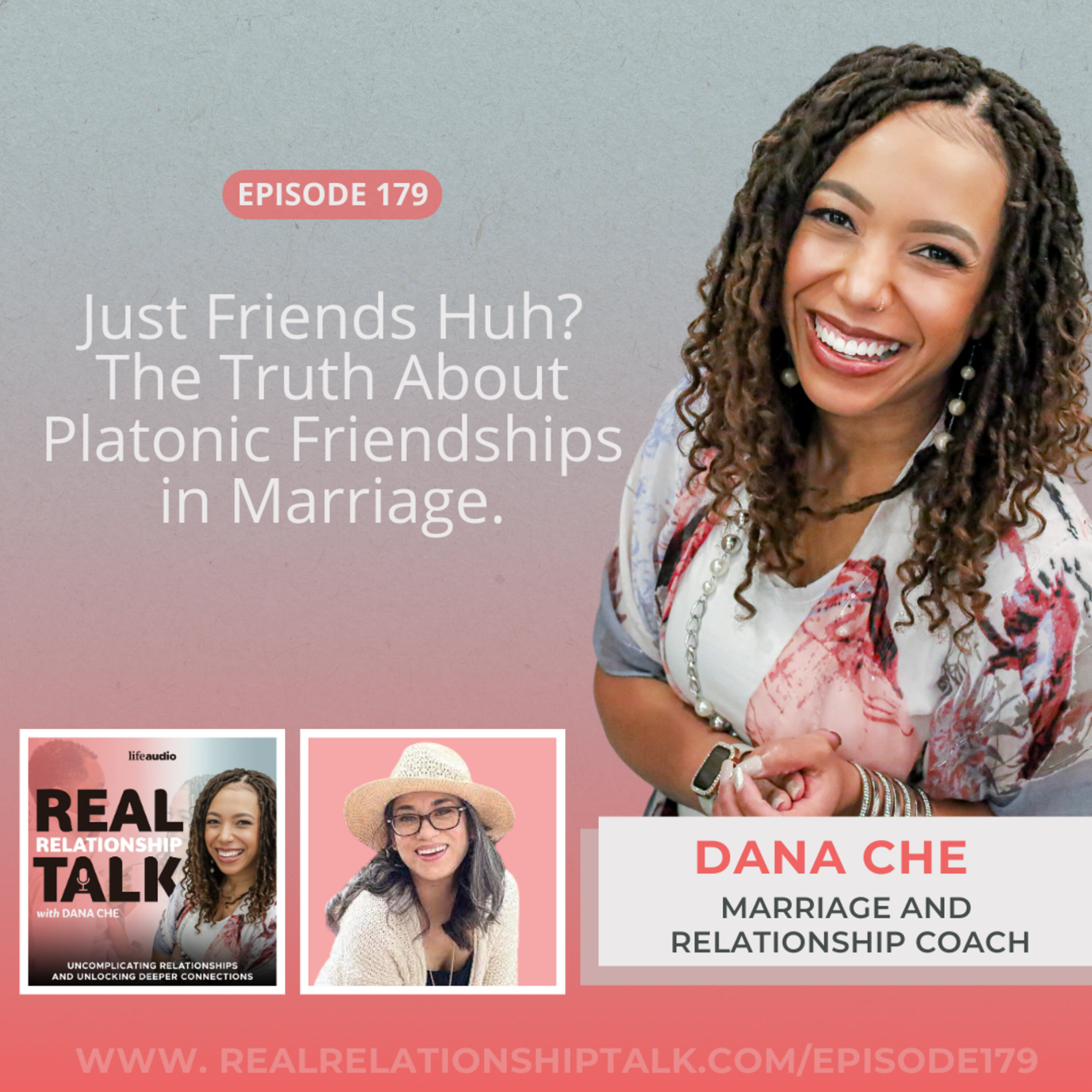


Ever wish there was an "easy" button for marriage? Or that you just had someone who understands the struggle?Rebuilding Us is a top-rated marriage podcast to help you restore intimacy, rebuild trust, and renew hope in your marriage. Join marriage coach Dana Che, who's been married to her hubby, Shaun, for 25 years as she guides couples on the journey toward restoration and connection.
Each episode includes real-life stories, practical strategies, and faith-filled insights to help you reignite love, deepen commitment, and create a thriving, joy-filled relationship. Say goodbye to Christian clichés—Dana’s relatable, no-nonsense approach (with a touch of humor!) will keep you coming back week after week.
Whether you’re healing from infidelity, seeking stronger communication, or simply longing for a closer bond, this podcast equips you with the tools and encouragement to rebuild not just your relationship but yourself.
Let the rebuild begin!
**New episodes drop every Tuesday and Friday. Subscribe now and take the first step toward your best marriage yet.
Welcome to Faith Fridays on Real Relationship Talk. We're bringing you an additional podcast episode each Friday on the topic of real faith. These short episodes will help you learn more about God and grow in your faith, seeing his work in your relationships. Today’s faith focus is becoming a peacemaker, and our scripture comes from Matthew 5:9.“God blesses those who work for peace, for they will be called the children of God (New Living Translation). Take the “How Connected a Partner Are You” Quiz today at https://danache.com/partnerquiz. To stay updated with show notes, helpful articles, and more relationship tips, visit https://realrelationshiptalk.com. We’d love for you to rate, review, and SUBSCRIBE to the podcast as your support enables us to continue delivering valuable relationship content to people around the world!Support the show: https://danache.com/donations/support-the-show/ Discover more Christian podcasts at lifeaudio.com and inquire about advertising opportunities at lifeaudio.com/contact-us.
What If I Married the Wrong Person? One of our listeners wrote in with a question: What if I married the wrong person? He went on to share that he felt bored, dissatisfied, and miserable in his marriage and wanted some advice on what he should do. He also confessed to being tempted by attention from other women, which heightened the thought that his wife is just not right for him anymore. In my typical candid but graceful way, I share my thoughts and advice to help not only him but anyone else who may wonder if they’ve married the wrong person to navigate this difficult situation. I can’t stress enough the importance of evaluating whether a person is the right fit for marriage before making a commitment. Regrettably, many people bypass these steps before walking down the aisle and end up feeling stuck in their marriages. This episode also discusses steps to reconnect when you feel disconnected, the responsibility of love, and how to stop being bored in your marriage. Get ready, it’s getting real REAL today! Take the “How Connected a Partner Are You” Quiz today at https://danache.com/partnerquiz. To stay updated with show notes, helpful articles, and more relationship tips, visit https://realrelationshiptalk.com. We’d love for you to rate, review, and SUBSCRIBE to the podcast as your support enables us to continue delivering valuable relationship content to people around the world!Support the show: https://danache.com/donations/support-the-show/ Discover more Christian podcasts at lifeaudio.com and inquire about advertising opportunities at lifeaudio.com/contact-us.
Forgiving What You Can’t Forget Pt. 2 We’re discussing part two of forgiving what you can’t forget and continuing to talk about the fourfold path to forgiveness. These references come from Desmond and Mpho Tutu's book The Book on Forgiving. It's an incredible book; so well written. When I read this book, it was like a really kind, sweet, older gentleman, uncle, grandpa, that kind of person, who was just, loves you through his words. That's the best way that I can describe it. It's such a compassionate, gentle book, but with powerful truths. Step 2 - Name the Hurt The next step in the fourfold path to forgiveness is naming the hurt. It's one thing for you to tell the story. For example, this thing happened to me, my husband was unfaithful, my wife depleted our bank account, whatever the situation is. But it's another thing for you to then name the hurt for you to actually get real about what was lost. What did you lose when that thing happened? Get real specific about that. I’ve had quite a few things happen in my life that have caused me grief, and I've just kind of moved on. Now, that's not to say that I haven't grieved at all, but if I'm honest, I probably skipped some steps because I don't like to feel sad. I don't like feeling sorrow. I don't like to think about loss. So to really be honest and real with myself about the fact that I really lost something there takes a lot of work. It takes a lot of honesty. It takes a lot of vulnerability to just sit with that and to realize that some of the things that you lost, you can never get back. If you were, God forbid, sexually assaulted as a child, you lost your innocence, and you won't be able to get that back. Now, that does not mean that you're damaged goods. It doesn't mean that your life is over and you're somehow always going to be walking around with a scarlet A on your forehead. Absolutely not. But it does mean that you have to acknowledge that something was lost. So a part of naming the hurt is super important because it allows you to stop pretending or minimizing what happened. It's one thing to, again, be general, I was hurt, I was betrayed, I was let down. It's another thing to say, this is the hurt. I lost my confidence, I lost my security, I lost the closeness that I felt with that person. I lost my safety, I lost my savings. Whatever it might be, whatever was lost. It's important that you're able to name that and not just the tangible things, but the Nontangibles. That's super important that we're able to do that. Be specific about what it is that you lost. Good Grief There's another book, and I'll link to this in the show notes of this podcast. It's called Good Grief by Granger Westburg. I read this book back in 2008 after my best friend passed away from breast cancer, and I've talked about this before on the show. I've told you just now that I'm not the greatest at dealing with grief. So I had to start seeing a grief counselor because I could not move on. Now, obviously, you're dealing with a very significant loss, like people expect you to grieve for a while, right? But this was different. It wasn't like I was in denial. I knew that she had died, but it really affected me in ways that I did not know what to do with. And so I started seeing a grief counselor. And that was one of the best decisions that I ever did because I think had I not started seeing that grief counselor, I probably would have just masked it under some religious jargon, like, “Oh, she's in glory, bless the Lord.” That's not what we need to do when we are going through loss and pain. We don't need to mask it in some religious ideology. ALSO LISTEN TO EP. 47: GRIEVING WITH HOPE Step 3 - Granting Forgiveness Step three is granting forgiveness. Now, I say this a lot, and I'm going to say it again, that forgiveness is both a choice and a process. You are not always going to feel like forgiving. And forgiveness is not just something as easy as just like, I forgive you. Okay, let's move on. It starts off as a choice, but then you have to work it out as a process. These four steps that I'm giving you today is the process, or a process. So when I tell you that you need to grant forgiveness, it is a choice. You have to get to a point where you realize that when you withhold forgiveness from someone, you're truly only hurting yourself in the long run. Scientific studies have shown what unforgiveness does to the human body. Our bodies were not meant to hold on to unforgiveness. Your body was not meant to hold on to unforgiveness. You were not created to hold that much pain, to absorb that much trauma unhealed. So when you choose not to forgive, you're choosing to stay stuck in your trauma and in your shame, and in your pain. I tweeted this years ago. It's not my original tweet, but “Holding on to unforgiveness is like drinking poison, expecting the other person to die.” Some of the people that we are not forgiving have gone on about their lives, and they are not thinking about you at all. They're not thinking about what they did. They're not thinking about your hurt. They're not thinking about anything. They are living their best life, and you're the one stuck in the trauma. How do you get out of it? Well, you choose to forgive them. Forgiveness is also not something that they earn. Forgiveness is a gift. They don't have to ever ask you for an apology. I know that's hard to hear because we want that. We need that. It's like, wait a minute, you hurt me. You need to apologize. And the truth is, in a perfect world, absolutely that would work. But not everybody's going to apologize. Maybe they don't think that what they did was wrong. Maybe they're a jerk. So maybe that person has died and they'll never be able to acknowledge what they did. They'll never be able to apologize. And this is why forgiveness is not predicated on someone asking for an apology. Forgiveness is simply a choice that you make. It's what you choose to do. I choose to forgive you, even if you're unworthy. Even if you never ask for my forgiveness. Even if you don't think you did anything wrong. This is hard. You all easier said than done. I get it. I get it. But when you choose to forgive, you release yourself. Yeah, you release that person, but you really release yourself. You release yourself from them having to pay you back for whatever they did. Forgiveness is a gift. And I think one of the things that really helps us to forgive others is realizing that we have been forgiven. When we realize that we're humans, and I know that sounds so oversimplified, like everyone's human, but truthfully, we have done things to others that we didn't intend to do. We have hurt other people. We have caused people pain. And sometimes we meant to and sometimes we didn't. So when we're able to get in touch with that side of ourselves, with our humanity, then it gives us grace for other people. It gives us compassion for other people. Even when they hurt us, it gives us empathy for other people. Forgiving Keeps Your Heart Tender Maybe you need to forgive yourself. Maybe you've done something that is just so horrible and you've not forgiven yourself. It's time for you to put yourself in the forgiveness box. It's time for you to give yourself some grace, some compassion, some empathy. And that is what happens when we choose to forgive. We set ourselves free. We set the other person free. Ephesians 4:32, one of my favorite scriptures, says, “Be kind one to another, tender-hearted forgiving one another, even as God, for Christ's sakes, has forgiven you.” Think about that. Tenderhearted. When you forgive, you keep your heart tender. You see when you choose to hold on to unforgiveness, it makes your heart hard and calloused. And you wonder why you can't love. You wonder why you can't bond. You wonder why there's a wall up between you and other people. It's because when you hold on to unforgiveness, it hardens you. It embitters you. But when you're able to forgive, you have a tender heart. You keep your heart soft and pliable and flexible. Maybe you think but then people are going to hurt you again. Maybe they will. But I'd rather have a tender heart that's open to love and that's open to accepting people and living with others with all of their weaknesses, all of their flaws, all of their insecurities, and mine vs being this hardened, tough person who's trying to protect myself from all the hurts in the world. Because guess what, friend? You can live like that all you want. And people are still going to figure out a way to hurt you. So you may as well live with a tender heart. Step 4 - Renew or Release the Relationship Step four is to renew or release the relationship. This is an important conversation here because there is a difference between forgiveness and reconciliation. There are some relationships that are not going to be able to be reconciled. Like I said earlier, there might be people in your life who have died. You can't be reconciled with them. There might be people in your life who are completely unsafe, and I've had to do that with some people. I will offer forgiveness, but we will not have a relationship. I'm not going to be bitter. I'm not going to egg your house. I'm not going to pray for your demise, but we will not be reconciled, and that is okay. You want to use those situations sparsely. You don't want that to be your M.O. for everybody. You don't want that to be how you treat people. But the truth is, there are some relationships that can be renewed. In Thrive Relationship Coaching, we talk about how to actually restore your relationships, but then even with that, I understand that there are going to be some relationships that are not going to be able to be restored. There are some relationships that aren't going to be able to be restored, but there are many relationships that can be. So how do you know the difference? How do I know if this relationship can be restored or if I need to be able to release it? Repentance? Is that person truly repentant? Are they willing to make repairs? If they're not willing to make repairs and if they're not repentant, well, then that leaves you with your answer. To Forget or Not Forget? Yes, there are times that you can wipe the slate clean, when have chosen to forgive. It’s then that you need to start over and wipe the slate clean. This is what it means to “keep no record of wrongs,” like it says in 1 Corinthians 13. This does not mean that love allows you to just be taken advantage of or that love never brings up wrongs. It said, keeps no record, meaning that you're not always throwing in the face something that your spouse or whoever did to you. So when you decide your relationship can be repaired, renewed, or restored, it's time to wipe the slate clean. Next, you do what the Bible teaches in Philippians 3: “forget what lies behind and you press forward to what lies ahead.” Now, the title of this episode is Forgiving What You Can't Forget. So am I contradicting myself? No. And neither is the word of God when it says forgetting what lies behind. God knows that we're human beings and we're not going to technically forget. But it means that you no longer focus on that thing. That thing is in your rearview mirror. So just like you driving down the street and you see some houses and some fields and some cars. When you pass those things, those things are in your past, they're done. You're probably not going to keep staring in your rearview mirror because then guess what? You'll miss everything that's in front of you. That's how healthy relationships work. Once you forgive, now it's behind you. That doesn't mean that you'll never think about it. That doesn't mean that you won't even sometimes reach back in the past to help other people with your story as I said earlier. But it does mean that you're no longer harping on that thing. You're no longer focusing on it. It's not tripping you up anymore. You're choosing to let the past be the past, and you're choosing to press ahead to what lies ahead in the future. And if you're not able to do that, then that relationship is not going to be restored or repaired. Release the Hurt So this brings us to our final point here, which is forgiveness is about releasing. It's about releasing the hurt. So just like we named the hurt, now it's about releasing the hurt. Just like you confronted the person, now it's about releasing the person. Just like you had to tell your story, now it's about releasing that story so that you can now tell a different story. God has used our story to bless many, many marriages so that they could know that there is truly nothing that you will go through in your marriage that God can't fix and heal so long as you're willing to do the work. And this is why we end every episode by saying that a good relationship is not one that works. A good relationship is one where you put in the work. You've got to put in the work. There's no magic wand fairy dust that God's doing for some people and not for others. That's not how it works. If you're willing to do the work, if you're willing to go through this process of forgiveness that we've talked about, anything can work. If you’re ready to do the work of restoring your relationship, schedule your discovery call with me at http://danache.com/getstarted. Links Mentioned in this Episode Episode 149: Forgiving What You Can’t Forget - Pt. 1 Episode 116: Love Keeps No Record of Wrongs - with Dr. J. Calvin Tibbs SUBSCRIBE | SHARE | RATE | COMMENT To ensure you never miss an episode, be sure to subscribe on Apple Podcasts, Google Play, Spotify, Stitcher, iHeart Radio, or wherever you listen to podcasts. Remember, sharing is caring! So, share these episodes with your friends and family via email or social media. Support the show: https://danache.com/donations/support-the-show/ Discover more Christian podcasts at lifeaudio.com and inquire about advertising opportunities at lifeaudio.com/contact-us.
Forgiving What You Can’t Forget - Pt. 1 Today we are going to go a little deep. We're going to do a little bit of excavation into your heart, perhaps to pull out some old memories that you would prefer to stay tucked away. We are going to go after the cover-up that you have put over some of those wounds, and we're going to make sure that what you have forgiven is really, indeed healed. For some, you’re listening to this episode today on forgiveness, because you haven't been able to forgive. You haven't been able to move on, and you need somebody to help you out. After this and next week’s episode, you will have a blueprint on how to get over what was done to you, how to forgive, and move on. The title of this episode is forgiving what you can't forget. And I know that we have so much to talk about, so I've actually split this episode up into two separate episodes. So we're going to talk about part one today and then next week join us because we are going to finish up with part two. Everybody Needs to Learn How to Forgive If there is one thing that I know for sure as a marriage coach, as a pastor, as a woman, and as a human being, it is that we all are going to have to walk through forgiveness at some point or another. You could have the most perfect marriage, the most healthy relationship, the best friendship, you name it, but at some point because you are in a relationship with another human being, you're going to be hurt and you are going to hurt. We need to understand that forgiveness isn't something that just really resilient strong people do. It isn't something that only struggling relationships have to go through. We all have to learn how to forgive. And the more that you do it, the easier it gets. So as I look back over my life, I can think of many people whom I've really had to forgive, really struggled to forgive. And here's the truth. The closer the person is to you, the harder it is to forgive. Because the people that are closest to us have the most ability or the greatest ability to hurt us the deepest. If I'm just upset with my coworker because they ate my lunch that I put in the refrigerator, well, I mean, I have to forgive that. But it's not like the end of the world versus if I have to forgive my husband who betrayed my trust. So regardless of who came to your mind, regardless of whom you're thinking about, what I'm going to share with you over these next two episodes is going to be completely applicable. The Inspiration Behind Forgiving What You Can’t Forget This episode is not intended to be a therapeutic session. It is not intended to be a full-out coaching session, even though coaching obviously will help you. And I do work with all of my clients on this process of forgiveness. Lysa TerKeurst, President of Proverbs 31 Women wrote a book called Forgiving What You Can't Forget. If you know anything about her story, Lysa was married for nearly 30 years to a man who was a habitual cheater. And her lifestyle is very public, especially for those in the Christian community. Many Christian women know who Lysa TerKeurst is as she has a very prominent ministry. She has lived this whole debacle out in the public eye. I have nothing but respect for her. I did a YouTube video on this very topic of her story on forgiveness about how I applauded her, really, for leaving this very toxic marriage. You all know me. I am for marriage. I am pro-marriage. I don't take divorce lightly at all. But in her situation, she was married to a man who she had given grace upon grace upon grace upon grace, chance after chance after chance after chance. They publicly renewed their wedding vows, and this man committed to being faithful and loyal and he wasn't. So she finally made the decision that she was going to need to walk away. And I know that that took a lot of courage. I'm sure that there are people who probably disagreed with her decision, and I'm sure that it was really like a battle within herself to even get to that point. But through her pain, she wrote this book called Forgiving What You Can't Forget, and that is really what inspired, obviously, the title of this podcast. Recommended Books on Forgiveness Another book I'm going to recommend to you is called The Book on Forgiving by Desmond Tutu and his daughter Mpho Tutu. Obviously, those are African names. This is such a good book. I originally got this book, I don't know, maybe three years ago. I think it was like right at the start of COVID. This book is really about a lot of what Desmond experienced coming out of apartheid and how he learned how to forgive. But it's not just the apartheid story, because most of us have not had that experience. But he really teaches about these tenets of forgiveness. And one of the most profound things, I think, that I have probably ever read in my whole life was out of this book. He talks about the fourfold path to forgiveness. The Fourfold Path to Forgiveness Today I'm going to teach something that I've never taught before, and it is this whole fourfold path to forgiveness. So the first thing, let me actually give you all four. And then, like I said, we're going to introduce this topic today and then we're going to continue this next week on this fourfold path. The first thing that you're going to want to do is tell your story. The second thing is to name the hurt. The third thing is to grant forgiveness. And then the last thing is to renew or release the relationship. When Is the Process of Forgiveness Complete? What does it look like when the process of forgiveness is complete? How do you know if you've really forgiven someone? I get asked that question a lot. One of the things that I always say is, first of all, you'll know when the process of forgiveness is complete when you can think about that memory and it no longer stings, it no longer burns. Let's say I burned myself with a curling iron, which I have many, many times, especially when I was a little kid. Not knowing what I was doing curling my hair. So I have a scar from the burn. If I look at that scar, then I remember exactly what happened there. I'm like, oh, yeah, I was eight years old. I was curling my hair in the bathroom at my house and felt the singe. I felt that thing on my neck. So I can think back to that memory. But if I touch that scar, it no longer hurts, it no longer burns, there's nothing oozing. It's completely healed. Likewise, my friend, when you think back over that memory, whatever happened, you think of that person and there's nothing that oozes emotionally. There's no more pain, there's no more stinging. That's when you know that the process of forgiveness is complete. I've written about forgiveness, even shared on an earlier podcast episode about forgiveness, and I've given lots of tips throughout many other episodes on this podcast on forgiveness. I talk about forgiveness so much because it a necessary in a healthy marriage or relationship. You simply cannot build a connection or commitment without learning how to forgive. I hope the lessons you hear in today’s episode jumpstarts your journey on the path of forgiveness and may you learn to forgive the things you can’t forget. ALSO LISTEN TO: The Power of Forgiveness in Relationships: Release Them, Restore You Links Mentioned in this Episode The Book on Forgiving by Desmond Tutu Forgiving What You Can’t Forget by Lysa TerKeurst Episode 18: How to Love Your Spouse When You Don’t Like Your Spouse SUBSCRIBE | SHARE | RATE | COMMENT To ensure you never miss an episode, be sure to subscribe on Apple Podcasts, Google Play, Spotify, Stitcher, iHeart Radio, or wherever you listen to podcasts. Remember, sharing is caring! So, share these episodes with your friends and family via email or social media.Support the show: https://danache.com/donations/support-the-show/ Discover more Christian podcasts at lifeaudio.com and inquire about advertising opportunities at lifeaudio.com/contact-us.
Ep. 148- 7 Reminders for Women in Struggling Marriages As I prayed through this episode, I asked the Lord, “What do you want your ladies . . . the women in struggling marriages to know?” If you imagine God the Father is so good as he is, whether you know Him or not, whether you believe in Him or not, he's still good and he still loves you, whether you acknowledge his presence or not. I imagine God the Father saying, “Come to me.” He is calling us into his presence and saying, “I have some things that I want you to know. I know that your marriage is struggling right now. I know that you're sad a lot. I know that you feel hopeless a lot. I know that you think that you're never going to make it out of this. I know that you're comparing your marriage to other people's marriages and you're scrolling through Instagram and looking at all the beautiful, happy couples and wondering why your marriage can’t be that way. I know you're looking back at your wedding photos and wondering where everything went wrong. I know that you cry at night and you think that nobody else hears you, nobody else sees you. Friend, I want you to know that there is a God in heaven who sees you and that no tear that you have ever cried is wasted. And maybe you don't even know how to pray. Maybe you've given up on prayer. Maybe you don't think prayer works. I'm going to encourage you today that God still sees you. And he sent me today to give you some reminders that while your marriage is struggling, you are not. 7 Things to Remember About Your Struggling Marriage 1. You are not alone. If I had somebody to tell me this when I was in the throes of all of my marriage dysfunction, that would have meant the world to me because I felt alone. I felt like I was the only person that was going through this. I felt like I was the only person who had a crappy marriage. I felt like everybody else “got it,” and somehow we didn't. And I felt alone in my own home. There’s no worse feeling than when you're married and feeling alone, feeling like the very person that you committed your life to is unreliable. The very man that you pledged your everything to, you can't stand on him, you can't support. He doesn't support you. He's not who you imagined that he would be. And that can be really hurtful. I want to tell you that you're not alone. What do I mean by that? I mean that there are many women who are in your shoes. And unfortunately, because of this whole shame thing, which we're going to talk about in just a second, we often don't share our stories with one another. A lot of times we go through marriage problems and life even alone, because we're afraid to reach out, because we don't want to be judged we don't want people to look down on us. We feel like we should be farther ahead than we are. And so because we're not reaching out and because other people are not reaching out to us, we believe that we're alone. But I want to tell you that you are not alone. 2. You have nothing to be ashamed of. When you are hurt by your husband for some reason, it's like you take on that shame. If you've ever been cheated on, you've ever gone through infidelity, you know exactly what I'm talking about. You will take on the shame of what your husband did to you. If your husband is verbally or emotionally abusive to you, you will take on that shame of his choices and you will feel like you did something wrong even though you didn't. Now, I'm not saying that you're a perfect wife and you don't have your things to own, but what I am saying is that you have nothing to be ashamed of that is not yours. If you are not the one causing the marital distress, you do not need to be ashamed of the marital distress. We are way too often embarrassed by our husband's choices, and you don't need to feel like that anymore. What he is doing is his doing. ALSO READ: How to Deal with Shame in Relationships 3. You are a better wife than you think you are. We are so hard on ourselves, ladies. We are so idealistic. I think that sometimes gets us into trouble. It gets us into beating ourselves up because we feel like we should be doing more. We should love our kids more. We should love our husbands more. We should cook more, we should clean more, we should work more. We should be more successful. We should have more money. We should “bring more to the table.” We should always be doing more, more and more. I have this little placard in my home office, and it says, You have enough. You do enough. You are enough. I look at that from time to time, because I can sometimes think, Dana, you could be doing more. You could be doing better. You could be doing it faster. You could be doing it greater, even in my marriage. I want you to know, Sis, that you're a better wife than you think you are. I promise you, if you were to ask your friends and your children, they would tell you that you are a better wife than you think you are. So start giving yourself some credit here. Are you doing everything perfectly? No. Do you have issues? Yes. Are there things that you need to grow in? Absolutely. But even still, you are better than you think. 4. Your husband's issues are not your issues. I talked about this when in the previous point. Your husband's problems are not your problems. Now, yes, because you're married, you're going to be affected by his issues or by his problems, but can I tell you that that man had problems before you all ever met. He had issues before you ever got married. And sometimes we end up taking on our husband's shame, our husband's problems, our husband's issues, and we begin to make them our own. This is a huge boundary violation. ALSO LISTEN TO: Episode 49 - 5 Boundaries Every Marriage Needs I talk about boundaries so much because when you do not have boundaries in your relationship, it causes all kinds of dysfunction. It causes you to take on more responsibility than you should. Your husband's problems. Let's say your husband's into porn and you're like, oh, my gosh, I'm not pretty enough. I'm not sexy enough. I need to lose more weight. I need to gain more weight. I need to be more this, more that. He was probably doing porn before you ever knew him. So his issues are not your issues. So don't take on his problems. This doesn't mean that we're uncaring and uncompassionate, and we're like, oh, well, that's not my problem, buddy. Figure it out. That's not what I'm saying. Pray for that man. Encourage him, and support him however you can, but do not allow his burden or his problem to be saddled upon you. So now you're so overwhelmed because you're taking on all this stuff that you were never intended to carry. One of my favorite scriptures in the Bible is where Jesus says to cast your cares on me because I care for you (I Peter 5:7). In Matthew, he says that his yoke is easy and his burden is light (Matthew 11:28-30). Jesus is saying, I have a burden for you that's easy and light. When we walk around so overwhelmed and pressed down and under so much stress, it's because we are carrying a yoke or a burden that we were never intended to carry. And quite often, friends, it's somebody else's burden. It's somebody else's problem. In this case, most likely your husband's issues. So kindly give those issues back to him. Let him own what is his, and you allow Jesus to give you a light and an easy burden. 5. Even if you're the problem, you’re not the problem. I want to tell you that even if you're the problem, you are not your problem. You are not a problem. Are you causing problems? Quite possibly. Do you have problems? Probably. But you are not your problem. Whatever “your problem is,” maybe you're the one who's unreliable or you're the one who's unfaithful. Even if you, as a woman, you're listening and you're the one. You don't have to be defined by your issue. Just like I told you a second ago to release your problems back to your husband and to let him own his problem, I want to tell you, too, Sis, that you need to own your problem, but you are not the problem. If you listen to this podcast, you have heard me say you are not the problem. The problem is the problem. Your husband is not the problem. The problem is the problem. You're not identified, or you shouldn't be identified by whatever problem you're facing in your marriage. Get help, seek out help, do whatever you need to do to overcome your problem, but realize that you are not your problem. 6. Your children (and husband) need to see your vulnerability. This is where I messed up in my own life and my parenting and my marriage. I wanted to be the strong mom all the time. I didn't want my kids to see me cry. I didn't want my kids to know what was going on in my marriage, which there's some wisdom in that. Like, your kids don't need to know everything, okay? But your kids do need to see that you are a real woman with real feelings and real emotions. Your kids don't need you to be strong 100% of the time, because how else are they going to learn how to process their sadness, their emotions, their disappointment, and their heartache if they never see you processing yours? I remember laying in the bed at night and crying my eyes out. And then, like, a kid would walk in the room, and I would, like, wipe my face real quick and put on the smiley face, and they would be like, “Mommy, are you crying?” “No, Mommy's not crying. Mommy's good. What's wrong?” And then I go straight into mom mode instead of bringing that child to me and saying, “You know what, yeah, Mommy is crying right now. Mommy is really sad about something.” When you do that, you do a few things and I've done it a few times, but not as much as I should have done. You give yourself grace to just be, to just be a human with hurt and feelings and pain and emotion, but also you give your children an opportunity to love on you. Kids have this capacity to just love and be. Kids have the gift of presence. And so when you allow yourself to be vulnerable in front of your children again, not telling them everything and certainly never putting down their dad, right? Like, don't ever do that. Don't ever say, “You know what? Daddy really hurt Mommy. Daddy is being a jerk.” Like, don't do that, okay? I don't believe in that. But when you're able to say something like, “You know what? My heart is really hurting right now. I'm really disappointed with some things that are going on right now.” You don't have to go into all the details, but let your child know that, yeah, I'm not always happy. And, while you’re at it, be vulnerable with your husband too. Intimacy requires vulnerability. I’m going to tell you something that sometimes husbands do things and they don't realize the pain that they are causing you. When you are strong and independent, sometimes your husbands think nothing gets you; nothing hurts you. So they can do stuff and don't realize the damage they're doing. Sometimes you need to let your husband see. You need to be more vulnerable with your husband and let him know that what he's doing hurts, that you're not this Teflon-tough woman that doesn't ever get upset about things or hurt by things. You're never afraid. No. You've got fears, you've got hurt, you've got pain, you got disappointment. It's okay to let your husband see that part of you, to be vulnerable in front of him. That's a risk, I know. Vulnerability always is. 7. Prayer works. I know that sounds so simple, but prayer gives you a softened heart and a sound mind. Listen, when you have been hurt by your husband, you will have the temptation to become hardened, to become apathetic. Like I don't care. Whatever. It doesn't matter. I'm just going to bide my time until my kids get older. I don't want you to live like that, friend. When you pray for your husband, do you know that it is impossible to hate someone you're praying for? It's just not possible. So if you find yourself struggling to love your husband, you find yourself struggling to like the man, would you pray for him? Because prayer softens your heart. I believe that it also softens his heart. But let's talk about you for a second. Prayer softens hearts. It allows you this greater capacity to love someone who's unlovable, to love a man who is maybe not loving you the way that you need to be loved. You can't do that on your own strength. You need the power of the Lord to help you with that. And when you pray and when you say, God, I need you to help me love this man, I need you to put a seal over my heart. Not a wall, right? Walls are impenetrable. That's not what we're asking for. But I need you to put a seal of protection over my heart so that I'm not continuously being hurt by this man. Because if we're continuously being hurt by someone, we won't reach out and love them because we're trying to protect ourselves. Let God protect you. Let him protect your heart. ALSO LISTEN TO: Episode 129 - How to C.O.V.E.R. Your Marriage in Prayer Links Mentioned in this Episode: Take the “How Connected Are You in Your Relationship” Quiz! Want to schedule a discovery call with me? http://danache.com/getstarted SUBSCRIBE | SHARE | RATE | COMMENT To ensure you never miss an episode, be sure to subscribe on Apple Podcasts, Google Play, Spotify, Stitcher, iHeart Radio, or wherever you listen to podcasts. Remember, sharing is caring! So, share these episodes with your friends and family via email or social media.Support the show: https://danache.com/donations/support-the-show/ Discover more Christian podcasts at lifeaudio.com and inquire about advertising opportunities at lifeaudio.com/contact-us.
What's Your Fighting Style? Conflict is a normal and healthy aspect of any relationship. So we don't have to be afraid of it anymore. We don't have to run away from conflict. We don't have to pretend that it's not there. We don't have to try to dress it up as something else. It is what it is. However, conflict is not fighting. When we “fight,” we all have a fighting style that’s our go-to approach to handling conflict. When I'm saying fighting for the sake of this episode, I'm not talking about “throwing blows.” I'm talking about how you deal with conflict. When something arises in your relationship and you disagree with your partner, you're having conflict, that conflict then turns into more of just a disagreement, but you're almost at a stalemate. How do you handle that? What is your fighting style? Three Fighting Styles The three specific styles are as follows: attack-attack, attack-defend, and silent-silent. In the attack-attack style, both partners are on the attack and cannot hear each other, making it impossible to solve problems and leading to a destructive cycle. In the attack-defend style, one partner is attacking and the other is defending themselves, creating a tit-for-tat dynamic that is not productive in resolving the underlying issues. In the silent-silent style, both partners avoid confrontation altogether and allow issues to fester and grow. Why Does Love Feel Like a Battlefield? You are never going to find the solution to whatever the situation is because if you’re spending so much time attacking one another. It's almost like you are in a battlefield. You've now become an enemy, a combatant of your partner. Years ago, singer Jordin Sparks actually wrote a song called Battlefield. Here are some of the lyrics of this song . . . See if you can relate. Why does love always feel like a battlefield, a battlefield, a battlefield? You know that song so this is how it goes. Okay. Don't try to explain your mind I know what's happening here One minute it's love and suddenly it's like, love is a battlefield. One word turns into a war. Why is it that the smallest things tear us down? My world's nothing when you're gone. I'm out here without a shield. Can't go back now. I never meant to start a war. You know I never want to hurt you. Don't even know what we're fighting for. Why does love always feel like a battlefield? Listen to Battlefield here Why does love always feel like a battlefield in your relationship? You feel like there is nothing that you do, nothing that you say is going to make a difference because your spouse is looking at you as the enemy. Or, you see your partner as the enemy. Break Free From Fighting To break out of these fighting styles, one person in the relationship must wave the white flag and prioritize the relationship over being right. Remember, your partner is not the problem; the problem is the problem. You are on the same team! By taking a step back and examining the real issue, couples can work together to find a solution. In order to move forward from fighting, couples must reframe the way they approach conflict. Instead of seeing it as a competition or an opportunity to prove who is right, couples should view it as a chance to grow and strengthen their relationship. If necessary, couples should take a “time-out” during particularly heated moments to allow both parties to cool down and come back to the conversation from a calmer and more rational place. Links Mentioned in this Episode: Episode 87: The Silent Treatment vs Arguing Register for the upcoming Thrive Wives workshop SUBSCRIBE | SHARE | RATE | COMMENT To ensure you never miss an episode, be sure to subscribe on Apple Podcasts, Google Play, Spotify, Stitcher, iHeart Radio, or wherever you listen to podcasts. Remember, sharing is caring! So, share these episodes with your friends and family via email or social media.Support the show: https://danache.com/donations/support-the-show/ Discover more Christian podcasts at lifeaudio.com and inquire about advertising opportunities at lifeaudio.com/contact-us.
The Power of Conflict: How Disagreements Can Strengthen Your Relationship Can conflict actually help you connect? The whole reason that I wanted to do this episode is to help you to understand that conflict can be a great asset in your marriage. Conflict can actually be a great asset in any relationship if you understand how to use it. Conflict is like a tool. And if you learn how to use the tool correctly, then you're going to find that it's not such a scary thing when conflict shows up in your relationships. So we have a jam-packed episode today, you guys. I'm going to be sharing lots and lots of skills, tools, and resources with you. But before we get into all of that, I want to ask you to do me a favor. Right after you finish listening to this episode, I would love for you to write a podcast review, especially if you are listening to this on Apple podcast or Spotify. Let me tell you why there are so many people who find out about this podcast by word of mouth. Shaun and I were in a restaurant, eating dinner with some friends. We were outside, and a couple walked past the table, and they were like, "I love your podcast. I love your podcast." And I was like, Oh, my gosh, I'm feeling famous. You know what I mean? And it was such a cool experience. But then, about ten minutes later, this other woman walks by our table, and she's like, "Oh, my gosh, I love your podcast. I listen to it every single week!" Why am I sharing this with you? Because both the couple and the woman who walked by heard about my podcast from a friend. So when you share this podcast, you have no idea the seeds that you are planting in your friends' lives. They might hear an episode that I did way back in 2020 or 2021 that will help to save their marriage. So by writing a simple review, you are helping this podcast to be found by people who really need it. So thank you so much for doing that. Let's Talk About Conflict So I like to talk about conflict, okay? I am not conflict-avoidant at all. Now, when I say that to people, it doesn't mean that I like to stir up trouble either. I don't like to create conflict. I'm just not afraid of it because I have learned that conflict is a tool in your marriage. But it's also a tool in any relationship. If you're a parent and you're dealing with conflict with your children, you can use that conflict to draw you closer to the relationship that you have to teach you more about your child, to teach you more about yourself. And of course, you can just sparse that out into any relationship that you're in. So I want to be able to give us some real practical takeaways today. As you listen to this episode, we're going to be talking about conflict as connection. If you've listened to my show for a while, you know that I talk about connection a lot. I'm going to give you five quick reasons, and I might throw in a bonus as to how conflict is connection or how conflict shows up as connection in your relationships. So the first thing is that conflict gets you talking. When you start to have issues in your relationship or issues in your marriage, there's some sort of disagreement, right? It's going to keep you talking. Now, you might not always say the right things or say them in the right way, but at least you're talking. You're getting your feelings out. You're sharing your emotions. You're being authentic, you're being honest about how you truly feel and what that particular thing is bringing up in you. Conflict Teaches You How to Speak Up So let's say, for example, you are having a disagreement with your spouse about parenting. My goodness, that happens to all of us in that connection. It might come up that you realize that when you were growing up, your parents were overly critical of you. Maybe you've never really thought about that before and how that shows up in your parenting, but you get into an argument with your spouse and you're like, you sound just like my dad. You sound just like my mom. My mom was always overbearing. My mom was always critical of me. And you didn't even realize that you were saying that until the words came out. Now, your spouse might not appreciate that you just said that about them, but if your spouse and you can take a step back and go, whoa, wait a minute. Okay, so this isn't really about my spouse. This is about my parents, and I'm being triggered by something that my spouse is doing. But, at the end of the day, I just had an epiphany. I just realized that I'm still dealing with some trauma or some struggles or some bad memories of how I grew up and how I felt like my parents treated me. And I'm kind of taking that out on my spouse. So when you're in conflict, it can help you to connect to your spouse because it gets you to talk. It gets you to say the things that you've been stuffing down inside. It gets you to say the things that you're thinking about, but you're not necessarily talking about. And so in that regard, conflict is a great connector. Conflict Teaches You When to Shut Up Now, number two is going to seem like a contradiction to what I just said in number one, and it's that conflict can get you to shut up. We just talked about it can get you to talk, but it can also get you to be quiet. It can get you to shut up when you're in conflict with your spouse. There's a point where you realize, I've said all the things that I need to say there's really nothing else to say, and so I'm done. Now, when I say I'm done, I don't mean like, I'm done. I'm walking out of the marriage or I'm walking out of the relationship. I mean, I'm done talking about that issue because there's really nothing else to be said about it. You all when we learn the appropriate times to shut our mouths, it can be incredibly helpful in our relationship. I was talking to someone today, a client of mine, and I told her, I said, there are times in our relationship that we have to learn. It's just like driving a car. You got to learn how to press the gas pedal down, and then sometimes you have to learn how to apply the brakes. So if you're always pressing that gas (i.e. working on your marriage, working on your relationship, talking about communication, fixing your communication), that's like the gas pedal . . . Well, at some point, your car is going to run out of gas. You have got to learn how to slow down sometimes, how to put the brakes on sometimes. And this is what I mean by silence or not talking and how that can actually help to create the connection in your marriage or your relationship. It's okay if you're not talking about all the issues and all the problems every single day. It's okay if you and your spouse get to a point and you're like, I really don't know what else to say about this particular thing. Take a breather. Now, you do need to come back at some point to that problem so that you could figure out where we go from here. Even if there's no "solution" to that problem, you still need to kind of tie up that loose end and say, we're not agreed here. Maybe there's no "solution" here, but where do we go from here? What's our next move? What's our next step? But before you get to that point, it's okay if there's some sort of putting the brakes on, if there's some sort of pause, if there's some sort of some quiet. I think it was about two years ago, I put a poll up in a Facebook group that I managed. It's called Christian Marriages and Relationships. Shameless plug. If you want to join that group, head on over to Facebook and join. I put up a poll in the group, and I asked them, I said, what do you think is more damaging in a relationship, silent treatments or angry outbursts? And it was an incredible post, and I love hearing from some of our members in that group. And actually, now that I think about it, I should probably do a whole podcast episode on that because we must talk about what are some of the benefits of both. Now, I don't believe that anger is really something that we are going to use as a helpful tool in marriage, but we can learn a lot about ourselves and our spouses when anger does show up. But I digress. Number two is that conflict can help you to connect to your spouse by getting you to shut up sometimes. Conflict Help You Connect By Teaching You About Your Partner Number three, conflict can act as a connection because it teaches you about your partner when you're angry about something in your marriage or when your partner, I should say, is angry about something in the marriage. It can teach you about them. It could teach you about their passion points, their values, what they hold dear, what they hold precious, what their opinions are, and what their perspective is. I am a big proponent of being a lifelong student of your partner. None of us should ever get to this point in our marriages or in our relationships where we feel like, I know my partner. We're good. There's nothing else to learn. I think when you get to that point in your relationship, your relationship has either died or is on the way to a slow death, we will never learn everything there is to know about our partner, because guess what? We grow. We evolve, and we change. So when you're in conflict, that can be a great teacher. You can start to learn, oh, wow. I did not know that my husband was insecure about such and such an issue. Oh, wow. I didn't know that. My wife was tender about that specific subject. So Shaun is a man of few words, and Shaun does not get angry very often. You guys like, honestly, I could probably count on one hand the times that I've seen him angry in our whole almost 24 years of marriage. But there are times when I push that little red button, and he will respond right. In some kind of way, and I'm like, Whoop. Okay, well, I guess he doesn't like when I say that, or I guess he doesn't like it when I do that, right? Read about John Gottman's Thoughts on Criticism & Contempt I can look at that conflict, and I can be like, oh, my gosh, look at him getting upset with me. Who does he think he is getting upset with me? He doesn't have a reason to get upset with me. What about what he did yesterday? What about what he did last week? I can do that. Or I can say, you know what? What is Shaun teaching me about himself right now? What am I learning about this man right now? Oh, I'm learning that he feels disrespected when I come at him in this kind of way, or he feels dishonored when I say this or when I don't say something to him. So in that regard, I can look at that conflict as a teacher. It's teaching me about my husband. If you look at conflict the same way it should be teaching you about your husband or your wife, about your partner. So that's just yet another way that conflict can be a connector because it teaches us about our spouse. Conflict in Marriage Teaches You New Skills The fourth thing that conflict does is that it teaches you new skills when you're in conflict and you can't figure out a solution, right? Like, have you ever been in a conversation with your partner? And it's just like I said, the number two tip that I share, is that conflict makes you shut up, right? There are times, you guys, that conflict will teach you how to approach the problem differently. What do they say the definition of insanity is? Doing the same thing, expecting different results, right? So if you are doing the same thing and you are not getting the results that you want, it's probably time to change it up. It's teaching you how to deal with the problem differently. Because if you do the same old things, you'll get the same old results. So if yelling and screaming and arguing is not working, which, newsflash, it does not work, then when you're in conflict, you can learn some new skills. Okay, well, maybe the yelling thing isn't really working for us. So what can we do now? What's next? What's new? And you'll learn. Okay, let's do this. I remember Shaun and I were in our mastermind that we did last month with some couples. And Shaun told them a story about how he and I had this disagreement once, and he said, "Hey, Dana, I need to talk to you about something, but I don't want you to respond for 24 hours." You guys, I thought I was going to die! 24 hours without talking is a long time. I like to talk. Okay? So I was like, oh, my gosh, I'm not going to be able to say anything that this man for 24 hours. Now, he didn't mean like, I can't talk to him, but he meant he did not want me to talk about that situation. And I was like, well, what am I supposed to do with 24 hours? Oh, my gosh, I have so many words and so many thoughts. But you know what I did? I thought I thought about what he said. I thought about what I said. I thought about what he meant. I thought about what I should be thinking, and something magical happened in 24 hours, you guys. And it was that my response to Sean was so different 24 hours later than it would have been if I would have given him an answer right away. He's a wise man, isn't he? There are times in your relationships when you're going to learn a new skill, a new tool. Shaun didn't get that out of a book. It was really spontaneous because he was tired of us dealing with this issue the same old way. So he's like, let's switch it up. Let's do something different. And now that has become one of our favorite go-to tools. When we are in an impasse, when we're dealing with conflict that we really can't get through, it's like, okay, let's come back to this thing in 24 hours. You think about it. I'll think about it. And guess what? In 24 hours, you guys, we almost always reconcile because whatever that thing was isn't even important anymore. We've had so much time to think about what is the real issue and what we're really feeling and what we're really dealing with, that whatever we were upset about, it doesn't matter. Usually in 24 hours. So that might be a tool that you can use in your relationship or when you're in conflict, what is something else that you can do? What's another tool that you can use to bring to that conflict to get a different result? And that is one of the greatest things that conflict teaches us. They teach us or it, I should say, teaches us new skills, new tools. Conflict in Relationships Shows You Who the Real Enemy Is Number five is that conflict teaches you who the real enemy is. I say this so many times that I feel like a broken record. Your spouse is not the problem. The problem is the problem. You need to look at your spouse, maybe right now if you're with them, or later on when you see them, and tell them you are not the problem. The problem is the problem. When you deal with conflict in your relationship, then you get to realize that, like, my spouse is not my enemy. We are on the same team here. We are together fighting a common enemy. And when you go through conflict, if you're aware and if you're wise enough to understand that, then you can get through anything together because you'll realize that your spouse isn't the problem. Your spouse isn't really the issue. Your spouse is your warrior friend. They really are. I know you might not think of your spouse in that way, but they really are your warrior friend. Even if they're not treating you nicely, even if you guys maybe aren't even talking right now, maybe you're in the middle of a silent treatment right now and you're like, they are not my warrior friend. I do not like them right now. Like, I get it, y'all, I get it. But your spouse is your warrior friend. And so when you can actually go through conflict with them instead of against them, then you realize what the real enemy is. Now, if you are a Christian listening to this podcast, you will know what I'm about to say. The real enemy is the enemy. It is the enemy himself who was out to steal, kill, and destroy, who hates marriage, who hates to see you thrive, who hates to see you win, who wants to destroy your marriage, wants to destroy your family, wants to destroy your legacy, wants to destroy your testimony. He's the real enemy. And what he does is he puts these little smoke and mirrors up in front of us and we begin to think, oh my gosh, I married the wrong person. Oh my gosh, my spouse doesn't love me anymore. Or oh my gosh, I don't love my spouse anymore. I've fallen out of love. Maybe John down the street is better suited for me. Maybe Susie down in the break room is actually who I really need to be with. And that's his play. He's done the same thing since the beginning of time. A Lesson About Conflict and the Blame Game Adam and Eve and the Garden blamed each other for the very thing that the enemy had caused them to do. So we have got to start getting wise, you all, and stop fighting each other and realize that we have a common enemy. Now, you might be thinking, literally, Dana, is Satan himself really against me and my marriage? Yes. Okay, but there are times that it might not be that deep, right? You might have an enemy that is more tangible or more in your face if you want to put it that way. You could be dealing with, let's say you're just dealing with unforgiveness. Well, unforgiveness is the enemy. It's not your spouse. You could be dealing with an addiction. Well, the addiction is the enemy, not your spouse. Now, that's not a reason to excuse bad behavior and be like, oh, it's not your fault, it's just the enemy. No, we still have to take personal responsibility, right? Because none of us are puppets on a string. We still have free will, we still have choice. But at the end of the day, we do need to understand that there is a real enemy out there who is seeking to devour, who's seeking to devour your marriage. And so when you understand that, then you can start taking your focus off of your spouse as the bad guy or the bad girl, and you can start to look at who's really behind the destruction of your marriage. Y'all, I could do an entire podcast on that alone. It's so important that you understand that fact now because I love you, I'm going to give you a bonus number six reason as to how conflict is actually connection. Conflict Can Be Great for Make-Up Sex Are you all ready for this one? Conflict helps you to have great makeup sex. I mean, it just does. You know, I was going there. It's true, it's true. Think of all the great makeup sex that you have had in your marriage. It's incredible. You're like, oh my gosh, I haven't talked to my spouse. I haven't touched them because I'm mad at them. And so, like, when their toe grazes my leg in the middle of the night, I snatch my leg away because I don't want them touching me at all. Am I in your house? Does anybody else do that other than me? Am I crazy self, right? It's like when you are in conflict with your spouse, you don't want to be touched, you don't want to connect with them. You don't want to look at them, you don't want to be near them. You're upset with them. And then when you make up, it's like all of that energy has just been like building up, building up, building up. And now you get to release it and the angels sing in heaven and it's glorious. It's amazing. Now, don't go getting on your spouse's nerves just to have great makeup sex. Like, over time, that's going to get old. But should you find yourself in conflict, just understand that in about two or three days, you're going to be great. You're going to be like, oh, okay. Funny, funny story; I remember. Well, it wasn't funny then, it wasn't funny then at all. It was pretty traumatic. But it's funny now because I'm on the other side of it. I remember Shaun and I had gone through this in-home separation. This is back in crazy, crazy times of our marriage, and we've been through many different crazy cycles. But this particular time we were going to do like this in-home separation because we didn't want the kids to know how bad it was. And so we were in this in-home separation and I was like, don't even think about coming in my room and getting in my bed. We are separated, okay? And so Shaun was like on his nicest behavior. Of course, he's trying to get back in my good graces. And I'm like, no, we're doing this in-home separation thing. And you guys, there was something about just being in the same house with this man. It was like electrical charges were flying all over the place. And I was trying to put on my game face and be strong and be like, you know what? No, we are doing this separation thing. And he was like, hey, can I give you a massage? No, do not touch me. But then it was like two days later, I'd be like, well, maybe just a shoulder massage. That's it, nothing lower, just a shoulder massage. And then like ten minutes later we were like having sex or something. I'm serious. That just is the truth. That's my truth. That's how it happens. Why am I telling you this? Because when you are married and you go through these seasons of conflict, on the other side of that, it can bring you closer together. It can bring you closer together. Not just sexual intimacy, but emotional intimacy. There is a bond that is created, yes, through sex, that helps the other forms of intimacy in your marriage. So when you're able to look at conflict as this thing is, it's not so scary, it's not so detrimental. It doesn't have to come and destroy your marriage. You don't have to be afraid of it. You don't have to shy away from it. You don't have to pretend that conflict isn't there. You can look at conflict and say, you know what? I am grateful for this conflict because it's going to get us to talking. It's also going to get us to shut up. It's also going to teach me about my partner. It's also going to teach us some new skills. It's also going to teach us who the real enemy is. And then it's also going to help us to have some incredible sex. Conflict is not that scary. So I hope, my friends, that this episode is going to help you the next time you find yourself in conflict to see all the beautiful benefits that can come out of it if you understand that conflict can actually be a support tool for you and your marriage. So that wraps up our episode today. I'm so glad that you are here with us today. I'm so glad that you are a faithful listener of this podcast. And maybe this is your first time. You're like, I ain't a faithful listener. This is my first time. You're going to be a faithful listener now, aren't you? So again, as I stated at the top of the show, I would appreciate it so much, you guys, if you would just take a minute or two and write a podcast review. You can do that on Apple podcast or Spotify and tell everybody you know about this podcast. I love meeting listeners, like I just told you, right here in Virginia Beach in my local area, where people will come up to me that I don't even know and say, I love your show, I love your podcast. That just makes me know that I'm hitting the target. And this is why Ido this, you guys. I do this podcast for you because I want to help you in your marriages. I want to give you some practical tools. I don't want to just show up every week and just talk about nothing. I'm right where you are. I'm building my marriage too. I'm growing my marriage, too. I'm reading the books. I'm going to the conferences. I'm building just like you're building. So let's build together. Let's thrive together. Let's grow together. You can find the show notes of this podcast at realrelationshiptalk.com/episode146, and oh, I can't believe I forgot to say this. A couple of years ago, I think it was in 2021, it may have been 2022, I did an episode called The Four Horsemen of the Apocalypse. It was episode 88. And if you've never heard of what the Four Horsemen are. You have got to listen to that episode. It's actually John Gottman who's, like, relationship guru extraordinaire. He came up with these four horsemen, these four really detrimental, destructive things coming out of a conflict that will destroy any relationship. So make sure that you listen to that one. Again, it's episode 88. And as we like to end every episode by saying a good relationship is not one that works. A good relationship is one where you put in the work. Links Mentioned in this Episode: Join the Christian Marriages & Relationships Group on Facebook Episode 88: The Four Horsemen of the Apocalypse Take the "How Connected a Partner Are You? Quiz SUBSCRIBE | SHARE | RATE | COMMENT To ensure you never miss an episode, be sure to subscribe on Apple Podcasts, Google Play, Spotify, Stitcher, iHeart Radio, or wherever you listen to podcasts. Remember, sharing is caring! So, share these episodes with your friends and family via email or social media.Support the show: https://danache.com/donations/support-the-show/ Discover more Christian podcasts at lifeaudio.com and inquire about advertising opportunities at lifeaudio.com/contact-us.
Truth’s Table: Race, Theology & Relationships - with Ekemini Uwan and Dr. Christina Edmonson Today we are so blessed to have with two midwives of Culture for Grace and Truth, Ekemini Uwan and Dr. Christina Edmonson, of the highly acclaimed and award-winning Truth’s Table Podcast. I have been listening to their podcast for a couple of years and when Hannah, our podcast editor, reached out to tell me we were going to have them on the show, I could hardly contain my excitement. Truths’ Table is a go-to podcast in the black, Christian community, and has even been featured on Grammy Award Winning Hip-Hop Artist, Lecrae’s album, All Things Work Together. Ekemini Uwan Ekemini and Christina share their much-needed perspectives on politics, race, culture, entertainment, and gender filtered through an accessible yet robust Christian theological framework. Ekemini is a public theologian and also a contributing writer for Hallmark Mahogany (which is my favorite brand of greeting cards by the way). Christianity Today named her among "10 New or Lesser-Known Female Theologians Worth Knowing. Ekemini has appeared on MSNBC, and her insights are quoted by NPR, CNN, The New York Times, The Washington Post, and The New Yorker among other publications. Ekemini is also single and shares her perspective on today’s show on living single. She writes a chapter in the book called Hidden in Plain Sight: A Single Black Woman’s Manifesto. Dr. Christina Edmonson Christina holds a PhD in Counseling Psychology, a Masters degree in Family Therapy, and a Bachelor’s degree in Sociology. She speaks and writes on leadership development, anti-racism, and mental health issues. Christina has been married for over two decades and shares some powerful truths about mutual submission and healthy marriage. Truths’ Table podcast, featured on Grammy Award Winning Hip-Hop Artist, Lecrae’s album, All Things Work Together and their book called Truth’s Table: Black Women’s Musings on Life, Love, and Liberation has been nominated for the 54th NAACP Image Awards! Get excited!! Let’s welcome the show Ekemini Oowan and Dr. Christina Edmonson. Relationships are complex as it is, but adding race to the mix can make things even more challenging. The ladies offer insights that could help us all navigate these relationships more thoughtfully. Colorism and Light-Skinned Privilege One of the most important themes that emerged in the episode was a conversation about colorism in the black community and the importance of acknowledging privilege. Christina spoke candidly about how the lighter-skinned privilege she experiences can lead to resentment and confusion in relationships with other Black women. She also recognized how societal and historical factors have contributed to her privilege, saying "It's hard to recognize my privilege because it feels like denying the pain and experiences of other people.” Dr. Christina Edmondson emphasized that it's important to reflect on our own privileges and how they impact our relationships. For example, she spoke about how Scripture has historically been interpreted primarily by men, and how this can have implications for how women are perceived in relationships. Men often hold positions of power in society and the church, and their hermeneutic might be self-serving in order to gain validation they don't get elsewhere. This conversation around privilege intersects with the topic of colorism, or the bias against people with darker skin tones, which can be especially damaging in relationships between Black men and women. Society has conditioned us to see lighter skin as warmer and kinder, and darker skin as mean and cold. Ekemini spoke about her own experience with colorism, where people have made negative assumptions about her personality or intellect based on the tone of her skin. ALSO LISTEN TO: Race Conversations 101: How to Have Civil, Compassionate, & Courageous Conversations About Race Submission in Marriage While the conversation around race and privilege can feel heavy, we also offered some practical insights that could help people to navigate relationships more effectively. Since this is a marriage podcast, we had to discuss the concept of submission in relationships. Christina spoke about the fear or discomfort some women may have around the idea of submission, but pointed out that mutual submission in a couple's relationship assumes equity, unlike a hierarchical relationship between a child and parent. Submission in a couple's relationship requires both partners to lay down preferences, and is ultimately an expression of love. Dating Challenges in the Social Media Age The episode also touched on the challenges of dating, particularly in the age of social media and dating apps. Ekemini spoke candidly about her own experiences, and how she prefers to meet people through mutual connections. However, due to the constraints of modern dating, she also uses dating apps. She is looking for someone who loves God, has good ethics, is kind, and aware of their issues and is willing to grow together. Past Trauma and Relationships Another major topic of the discussion was how past trauma can impact marriages and relationships. The guest speakers emphasized the importance of self-reflection and facing mirrors that show our flaws. Unacknowledged trauma can seep into marriages and cause pain and issues, which is why it's important to name and reconcile any painful experiences. Authentic Conversations about Race At its core, this podcast episode offers a testament to the power of authentic conversations and reflection in relationships. Ekemini and Christina’s genuine friendship is evident throughout the episode, and they come from a place of vulnerability and honesty. It's clear that there are no easy answers when it comes to navigating relationships and race, but by participating in these conversations, we can learn and be challenged in new ways. We're not going to get all the answers in one podcast. We need to keep having these conversations, where people are learning, growing and pushing boundaries. And this is the beginning. As the host of Real Relationship Talk, it is my honor to present and do this important work by fostering conversations around relationships and race that are thoughtful, honest, and vulnerable. By engaging with these conversations and reflecting on our own experiences and privileges, we can all work towards building more loving and understanding relationships, with ourselves and with others. Links Mentioned in this Episode Take the Free "How Connected Are You?" Quiz! Learn more about Truth's Table SUBSCRIBE | SHARE | RATE | COMMENT To ensure you never miss an episode, be sure to subscribe on Apple Podcasts, Google Play, Spotify, Stitcher, iHeart Radio, or wherever you listen to podcasts. Remember, sharing is caring! So, share these episodes with your friends and family via email or social media.Support the show: https://danache.com/donations/support-the-show/ Discover more Christian podcasts at lifeaudio.com and inquire about advertising opportunities at lifeaudio.com/contact-us.
Confessions of a Crappy Christian - with Blake Guichet Are you a Christian who struggles with some aspects of the faith? Do you have more questions than answers? Today, I’m talking with Blake Guichet, author and podcast host of Confessions of Crappy Christian, about her story of the deconstruction and reconstruction of her faith. We ask and answer some questions we had and still have about the Christian faith. We also discuss how we, as Christians, need to develop the art of better listening skills, especially when talking to someone about matters we disagree on. I truly believe we are all capable of honoring others even when disagreeing on values and/or beliefs. There are some “non-negotiables” about the Christian faith that are sacred, like the authority of Jesus Christ and what his death and resurrection signifies. However, there are “minors” that some Christians “major” on that only perpetuate a divide within our own faith and the impending faith of others. The Curious Christian Blake and I discuss how, as parents, it is very important to allow space for our children to be curious . . . to ask all the questions about the Christian faith we want them to embody. As children, we were both disappointed with a lot of the pat answers we received when we asked real questions about faith, gender roles and rules, and other topics. That experience taught me to truly listen to my curious children and keep listening to my curious self. The curious Christian is a growing Christian. The day curiosity leaves and replaced with certainty is the day faith is no longer needed. It’s okay to not understand every aspect of the Christian faith. It’s okay to not have all the answers you’re seeking either. Faith is indeed, “the substance of things hoped for; the evidence of things not seen” (Hebrews 11:1). Deconstruction of Destruction? “A lot of what I feel is happening today isn’t deconstruction but destruction,” Blake said, when I asked about her take on the topic of deconstruction in culture today. She goes on to say that people aren’t necessarily asking questions about faith in order to rebuild what needs to be rebuilt; they are just leveling the whole thing when they don’t understand something. When Blake went through her questioning and deconstructing phase (which is ongoing, by the way), her goal was to extract the inaccuracies she had been taught in order to replenish her faith with what is real and true and still holds. I can attest to this myself. I am grateful that we serve a God who is not afraid or offended by our questions; who is not moved off his throne by our doubt. He is able to keep what we have committed to him (our hearts) through any and every season (2 Timothy 1:12). Links Mentioned During This Episode How Connected a Partner Are You? Take the Free Quiz! Learn more about Blake and Hear Her Podcast SUBSCRIBE | SHARE | RATE | COMMENT To ensure you never miss an episode, be sure to subscribe on Apple Podcasts, Google Play, Spotify, Stitcher, iHeart Radio, or wherever you listen to podcasts. Remember, sharing is caring! So, share these episodes with your friends and family via email or social media. Support the show: https://danache.com/donations/support-the-show/ Discover more Christian podcasts at lifeaudio.com and inquire about advertising opportunities at lifeaudio.com/contact-us.
Overcoming Father Wounds - with Kia Stephens Fatherlessness is at an all-time high. The pain of growing up without a dad isn’t something that just leaves you. Today, we’re talking with Kia Stephens, author of Overcoming Father Wounds: Exchanging Your Pain for God’s Perfect Love. Kia shares her story of what life was like growing up with an absentee father and the road she walked to forgiveness. You’ve likely heard of daddy-less daughters and fatherless families. But what isn’t often talked about is what is required on the part of the abandoned child (who is likely now an adult) to bring healing and wholeness to their life. Abandonment Breeds Rejection Kia acknowledges the rejection she felt by her father’s abandonment. Without a doubt, abandonment breeds the seed of rejection in our lives. Many grown men and women today are still hurting from the rejection they felt once their dads left. Typically, fathers provide a deeper level of identity and affirmation to a child, so when he is not there, that child is left with wounds that are hard to heal. Kia calls these affirmation wounds, love wounds, and acceptance wounds. But what about moms? Can’t moms fill in the gaps for the gaps absentee fathers leave? Unfortunately, no. Though the role of mom is very important, it’s the covering of a father that most children crave. Rejection makes us feel unwanted. Kia tells a story of a friend who casually mentioned building a bookshelf with her dad. The pain of that simple story made such an impact on Kia as she realized she would never build anything with her own dad. There would be no camping trips, long conversations, or other “normal” things that many girls that did have their fathers around would experience. And there again, the cycle of rejection is solidified. Physically Present But Emotionally Absent Maybe your father was physically present but emotionally absent. That can hurt just as bad, and sometimes even worse. If you grew up with a father who was an alcoholic or other kind of addict, emotionally absent, abusive, etc., you likely dealt with the same father wounds. Let this be a charge to the fathers who are still present in the home: proximity doesn’t equal presence. Being present is being fully vested in the relationship: body, mind, and soul. Forgiveness is the Key The only way to heal the wound of fatherlessness is through forgiveness. Kia talks about the process she had to walk through to forgive her father. And hear me, forgiveness is not optional. I know that it’s hard, but forgiveness is not just for the other person, but ultimately for you. When you forgive, you set yourself free from the shame, the pain, the loss, the sorrow, the anger, and the need to retaliate. You become free even if/when the other person can’t or won’t acknowledge what they did to you. Kia was encouraged to write a forgiveness latter: basically a letter “getting it all out there.” The caveat is that you don’t actually send the letter to the person who harmed you (in this case, your father), but you use it as a powerful tool of asserting your feelings, thoughts, and emotions. Again, forgiveness is for you. ALSO LISTEN TO: The Power of Forgiveness: Release Them, Restore You There’s much more to this episode! Be sure to listen to the episode in full. Links Mentioned in this Episode Get Kia’s book Overcoming Father Wounds Learn more about Kia at kiastephens.com. How Connected of a Partner Are You? Take the Free Quiz! SUBSCRIBE | SHARE | RATE | COMMENT To ensure you never miss an episode, be sure to subscribe on Apple Podcasts, Google Play, Spotify, Stitcher, iHeart Radio, or wherever you listen to podcasts. Remember, sharing is caring! So, share these episodes with your friends and family via email or social media.Support the show: https://danache.com/donations/support-the-show/ Discover more Christian podcasts at lifeaudio.com and inquire about advertising opportunities at lifeaudio.com/contact-us.
Dana Che is the founder of Thrive Relationships, where she serves as a marriage and relationship coach and host of the Rebuilding Us marriage podcast. She also serves as a preaching pastor at her church. Whether in the church or on her podcast, Dana's mission is singular: to help people rebuild their relationships through the grace and guidance of the Lord.
On Rebuilding Us, she is known for her graceful candor, humor, and her encouraging yet challenging advice. Dana holds a B.A. in communication from Regent University. She has a fierce passion for fashion and a fiercer passion for truth. She shares her life with Shaun, her loving husband of over twenty-five years, their four amazing children, and their “multi-cultural” dog in beautiful Virginia Beach, VA.