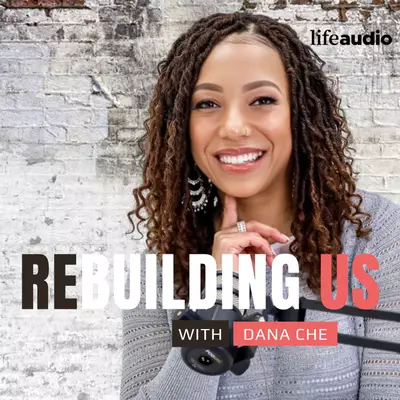
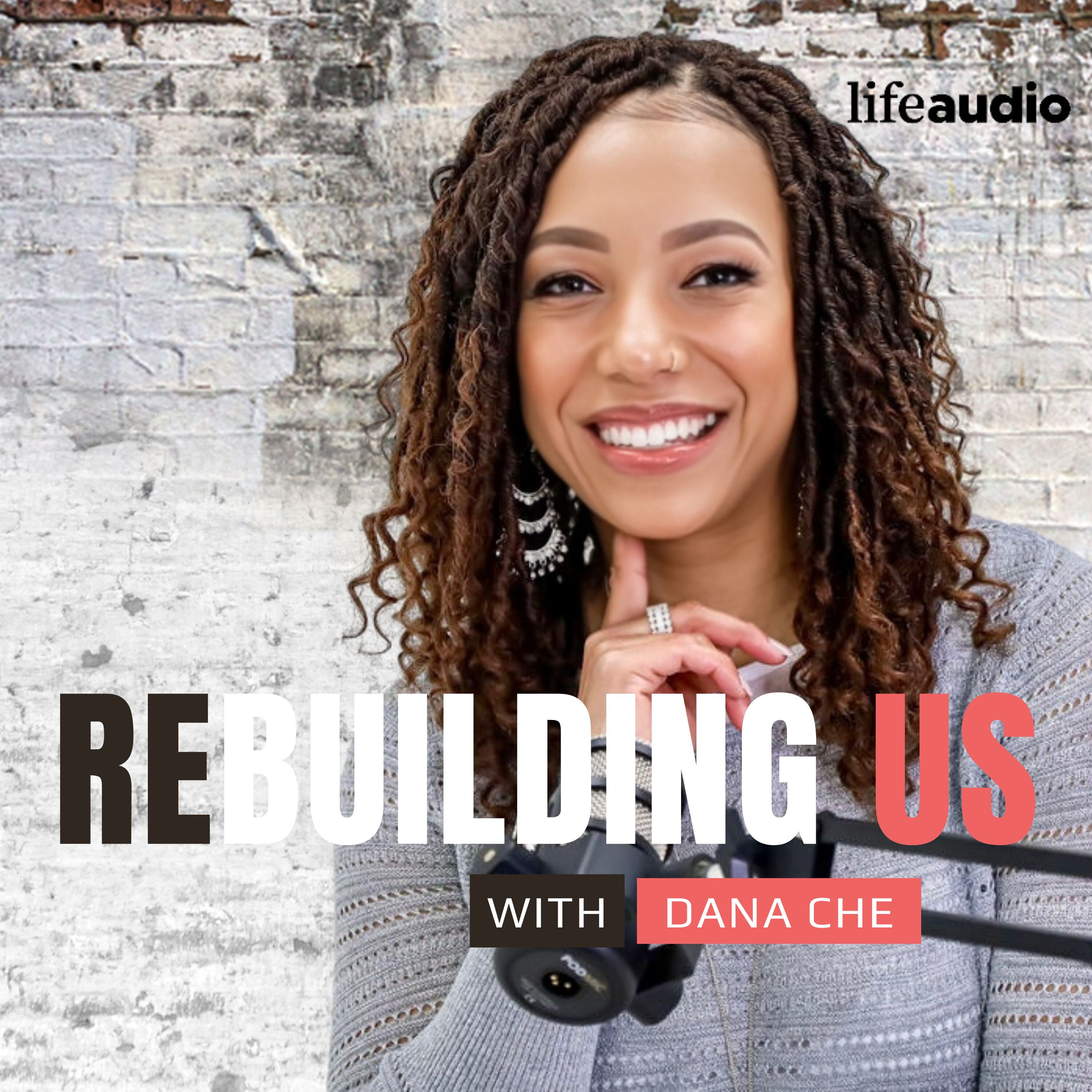
Rebuilding Us is a Christian marriage podcast for couples seeking relatable marriage advice, biblical encouragement, and real hope. With her signature no-nonsense approach, marriage coach and author Dana Che brings truth and grace to the hard conversations couples often avoid—while weaving in just enough humor to make the heavy topics feel a little lighter. Each episode helps couples rebuild trust, improve communication, restore intimacy, heal after infidelity, and reconnect emotionally and spiritually.
Through honest conversations, real-life stories, faith-filled wisdom, and practical relationship tools, Dana offers a clear approach to navigating conflict, betrayal, disappointment, and disconnection—without shame, clichés, or unrealistic expectations.
Whether you are recovering from infidelity, strengthening an already-good marriage, or simply longing for a closer bond, this podcast will help you create a healthier, more connected, Christ-centered relationship.
New episodes are released every Tuesday. Follow Rebuilding Us and begin your journey from conflict to connection.
Can you imagine how weird it would be to see a leg hobbling down the street on its own or a hand floating through the air unattached? #StrangerThingsBut isn't that exactly what happens when Christians "detach" from the church, because of offense, apathy, or just plain ol' boredom? Today's faith focus is from Ephesians 4:16: He makes the whole body fit together perfectly. As each part does its own special work, it helps the other parts grow, so that the whole body is healthy and growing and full of love (NLT).Some questions to ponder:1. If He (God) makes the whole body fit together perfectly, what does that say of someone who is detached from the body?2. What "special work" are you doing in the Body?3. How are you helping others in the Church (the Body) to grow? I'd love to hear your faith find from today's episode. After you listen to the episode, share your faith find (your takeaway) with me here OR in your Instagram or Facebook stories and tag me @mrsdanache (Instagram) or @therealrelationshiptalk (Facebook), and I'll repost you! To stay updated with show notes, helpful articles, and more relationship tips, visit https://realrelationshiptalk.com. We’d love for you to rate, review, and SUBSCRIBE to the podcast as your support enables us to continue delivering valuable relationship content to people around the world!Support the show: https://danache.com/donations/support-the-show/ Discover more Christian podcasts at lifeaudio.com and inquire about advertising opportunities at lifeaudio.com/contact-us.
When You Disagree on How to Discipline the Kids (Marriage & Family Series) When parenting your children, disagreements don't have to come between you and your spouse. So what do you do when you and your spouse disagree on how to discipline the kids? Shaun and I have had many disagreements concerning our kids. It can tear your marriage apart when you disagree on discipline. I want us to focus on this topic because our goal is to share a little bit about our story, our failures, and some things that we figured out along the way, in the hopes that you will also be able to learn how to navigate forward. Spoiler alert: it is possible to agree on your outcomes, even if not necessarily on your tactics. Most of us want our kids to thrive, and to be healthy, whole, loving, responsible people. So, join Shaun and me in this conversation. We're shedding some light and some wisdom on how to come to a truce when your parenting styles are misaligned. LINKS MENTIONED IN THIS EPISODE Learn more about Thrive Wives, our group coaching program How Connected a Partner Are You? Take the free quiz to find out! Support the show: https://danache.com/donations/support-the-show/ Discover more Christian podcasts at lifeaudio.com and inquire about advertising opportunities at lifeaudio.com/contact-us.
Today's faith focus is from Romans 8:18. There are 4 different types of suffering: suffering that we bring on ourselves (think of the Israelites/Jews in the Bible); suffering that others bring on us (think of Joseph); suffering related to spiritual warfare (think of Job); and suffering for a greater purpose (think of Jesus). Regardless of the type of suffering you're enduring, you can survive and endure when you focus on what lies ahead . . . the "greater glory," as Paul puts it. Remember, your best days are yet ahead. You can make it through this suffering season and fulfill God's plan for your life. Learn more about Dana Che, marriage and relationship coaching, or how to invite her to speak at your event at https://danache.com. To stay updated with show notes, helpful articles, and relationship tips, visit https://realrelationshiptalk.com. Enjoying the show? Give it a 5-star rating, review, and SUBSCRIBE to the podcast! Support the show: https://danache.com/donations/support-the-show/ Discover more Christian podcasts at lifeaudio.com and inquire about advertising opportunities at lifeaudio.com/contact-us.
Why Your Kids Need You to "Get a Room" (Marriage & Family Series) Today we are going to get into some sex talk. This episode is going to be hot. It's going to be a bit spicy and steamy. We're talking about sex and why your kids need to see appropriate sexual affection.. How many of you have heard your kids say “Get a room!”? Shaun and I have this goal, if you will, to make our children uncomfortable and remind them that before you ever arrived on the scene, we had a very vibrant, beautiful sex life. Many parents get so anxious and nervous about "the sex talk," but I want to tell you that if you're practicing healthy sexual affection in front of your children, then having that sex talk is going to be that much easier because you're already really laying the foundation. Your children need to know that you all not only love each other but that you like and enjoy each other. Displaying appropriate sexual affection in front of your kids helps them feel secure and counteracts the damaging over-sexualized messaging from the media. LINKS MENTIONED IN THIS EPISODE Learn more about Thrive Wives, our group coaching program How Connected a Partner Are You? Take the free quiz to find out! Support the show: https://danache.com/donations/support-the-show/ Discover more Christian podcasts at lifeaudio.com and inquire about advertising opportunities at lifeaudio.com/contact-us.
Welcome to Faith Fridays on Real Relationship Talk. We're bringing you an additional podcast episode each Friday on the topic of real faith. These short episodes will help you learn more about God and grow in your faith, seeing his work in your relationships. Today’s faith focus is from Proverbs 25:28 and is about cultivating self-control and how doing so is the true path to freedom. It reads, "Like a city that is broken into and without walls, so is a person who has no self-control over his spirit" (NASB). Many people think that the ultimate freedom is doing whatever you want. That’s not the ultimate freedom. Real freedom is the ability to control yourself and restrain yourself from doing whatever you want. Unbridled access leads to bondage, not freedom. And too much of even a good thing can be harmful. Learn more about Dana Che and our marriage and relationship coaching at https://thriverelationships.us. To stay updated with show notes, helpful articles, and more relationship tips, visit https://realrelationshiptalk.com. We’d love for you to rate, review, and SUBSCRIBE to the podcast as your support enables us to continue delivering valuable relationship content to people around the world!Support the show: https://danache.com/donations/support-the-show/ Discover more Christian podcasts at lifeaudio.com and inquire about advertising opportunities at lifeaudio.com/contact-us.
7 Lessons Your Marriage is Teaching Your Kids (Marriage & Family Series) As parents, your marriage speaks loudly to your children, whether good or bad - healthy or struggling. Your kids are watching everything. And let me tell you, kids are very perceptive. Kids understand way more than we give them credit for. In today’s podcast, we are discussing seven lessons your marriage is teaching your children: from conflict resolution to grace and forgiveness, appreciation, inner vows, boundaries, gender roles, healthy sexuality, and more, your marriage is sending some powerful lessons. Be sure to listen to the full episode and learn how to create a marriage your children will want to emulate. Wondering how connected a partner you are in your relationship or marriage? Take the free Partner Quiz today! https://danache.com/partnerquiz For wives looking for support, encouragement, and growth, join Thrive Wives, our bi-weekly group coaching program. https://thrivewives.com. We’d love for you to rate, review, and SUBSCRIBE to the podcast! Your support enables us to continue delivering valuable relationship and marriage advice and content to people worldwide! Support the show: https://danache.com/donations/support-the-show/ Discover more Christian podcasts at lifeaudio.com and inquire about advertising opportunities at lifeaudio.com/contact-us.
Welcome to Faith Fridays on Real Relationship Talk. We're bringing you an additional podcast episode each Friday on the topic of real faith. These short episodes will help you learn more about God and grow in your faith, seeing his work in your relationships. Today’s faith focus is becoming a peacemaker, and our scripture comes from Matthew 5:9.“God blesses those who work for peace, for they will be called the children of God (New Living Translation). Take the “How Connected a Partner Are You” Quiz today at https://danache.com/partnerquiz. To stay updated with show notes, helpful articles, and more relationship tips, visit https://realrelationshiptalk.com. We’d love for you to rate, review, and SUBSCRIBE to the podcast as your support enables us to continue delivering valuable relationship content to people around the world!Support the show: https://danache.com/donations/support-the-show/ Discover more Christian podcasts at lifeaudio.com and inquire about advertising opportunities at lifeaudio.com/contact-us.
What If I Married the Wrong Person? One of our listeners wrote in with a question: What if I married the wrong person? He went on to share that he felt bored, dissatisfied, and miserable in his marriage and wanted some advice on what he should do. He also confessed to being tempted by attention from other women, which heightened the thought that his wife is just not right for him anymore. In my typical candid but graceful way, I share my thoughts and advice to help not only him but anyone else who may wonder if they’ve married the wrong person to navigate this difficult situation. I can’t stress enough the importance of evaluating whether a person is the right fit for marriage before making a commitment. Regrettably, many people bypass these steps before walking down the aisle and end up feeling stuck in their marriages. This episode also discusses steps to reconnect when you feel disconnected, the responsibility of love, and how to stop being bored in your marriage. Get ready, it’s getting real REAL today! Take the “How Connected a Partner Are You” Quiz today at https://danache.com/partnerquiz. To stay updated with show notes, helpful articles, and more relationship tips, visit https://realrelationshiptalk.com. We’d love for you to rate, review, and SUBSCRIBE to the podcast as your support enables us to continue delivering valuable relationship content to people around the world!Support the show: https://danache.com/donations/support-the-show/ Discover more Christian podcasts at lifeaudio.com and inquire about advertising opportunities at lifeaudio.com/contact-us.
Forgiving What You Can’t Forget Pt. 2 We’re discussing part two of forgiving what you can’t forget and continuing to talk about the fourfold path to forgiveness. These references come from Desmond and Mpho Tutu's book The Book on Forgiving. It's an incredible book; so well written. When I read this book, it was like a really kind, sweet, older gentleman, uncle, grandpa, that kind of person, who was just, loves you through his words. That's the best way that I can describe it. It's such a compassionate, gentle book, but with powerful truths. Step 2 - Name the Hurt The next step in the fourfold path to forgiveness is naming the hurt. It's one thing for you to tell the story. For example, this thing happened to me, my husband was unfaithful, my wife depleted our bank account, whatever the situation is. But it's another thing for you to then name the hurt for you to actually get real about what was lost. What did you lose when that thing happened? Get real specific about that. I’ve had quite a few things happen in my life that have caused me grief, and I've just kind of moved on. Now, that's not to say that I haven't grieved at all, but if I'm honest, I probably skipped some steps because I don't like to feel sad. I don't like feeling sorrow. I don't like to think about loss. So to really be honest and real with myself about the fact that I really lost something there takes a lot of work. It takes a lot of honesty. It takes a lot of vulnerability to just sit with that and to realize that some of the things that you lost, you can never get back. If you were, God forbid, sexually assaulted as a child, you lost your innocence, and you won't be able to get that back. Now, that does not mean that you're damaged goods. It doesn't mean that your life is over and you're somehow always going to be walking around with a scarlet A on your forehead. Absolutely not. But it does mean that you have to acknowledge that something was lost. So a part of naming the hurt is super important because it allows you to stop pretending or minimizing what happened. It's one thing to, again, be general, I was hurt, I was betrayed, I was let down. It's another thing to say, this is the hurt. I lost my confidence, I lost my security, I lost the closeness that I felt with that person. I lost my safety, I lost my savings. Whatever it might be, whatever was lost. It's important that you're able to name that and not just the tangible things, but the Nontangibles. That's super important that we're able to do that. Be specific about what it is that you lost. Good Grief There's another book, and I'll link to this in the show notes of this podcast. It's called Good Grief by Granger Westburg. I read this book back in 2008 after my best friend passed away from breast cancer, and I've talked about this before on the show. I've told you just now that I'm not the greatest at dealing with grief. So I had to start seeing a grief counselor because I could not move on. Now, obviously, you're dealing with a very significant loss, like people expect you to grieve for a while, right? But this was different. It wasn't like I was in denial. I knew that she had died, but it really affected me in ways that I did not know what to do with. And so I started seeing a grief counselor. And that was one of the best decisions that I ever did because I think had I not started seeing that grief counselor, I probably would have just masked it under some religious jargon, like, “Oh, she's in glory, bless the Lord.” That's not what we need to do when we are going through loss and pain. We don't need to mask it in some religious ideology. ALSO LISTEN TO EP. 47: GRIEVING WITH HOPE Step 3 - Granting Forgiveness Step three is granting forgiveness. Now, I say this a lot, and I'm going to say it again, that forgiveness is both a choice and a process. You are not always going to feel like forgiving. And forgiveness is not just something as easy as just like, I forgive you. Okay, let's move on. It starts off as a choice, but then you have to work it out as a process. These four steps that I'm giving you today is the process, or a process. So when I tell you that you need to grant forgiveness, it is a choice. You have to get to a point where you realize that when you withhold forgiveness from someone, you're truly only hurting yourself in the long run. Scientific studies have shown what unforgiveness does to the human body. Our bodies were not meant to hold on to unforgiveness. Your body was not meant to hold on to unforgiveness. You were not created to hold that much pain, to absorb that much trauma unhealed. So when you choose not to forgive, you're choosing to stay stuck in your trauma and in your shame, and in your pain. I tweeted this years ago. It's not my original tweet, but “Holding on to unforgiveness is like drinking poison, expecting the other person to die.” Some of the people that we are not forgiving have gone on about their lives, and they are not thinking about you at all. They're not thinking about what they did. They're not thinking about your hurt. They're not thinking about anything. They are living their best life, and you're the one stuck in the trauma. How do you get out of it? Well, you choose to forgive them. Forgiveness is also not something that they earn. Forgiveness is a gift. They don't have to ever ask you for an apology. I know that's hard to hear because we want that. We need that. It's like, wait a minute, you hurt me. You need to apologize. And the truth is, in a perfect world, absolutely that would work. But not everybody's going to apologize. Maybe they don't think that what they did was wrong. Maybe they're a jerk. So maybe that person has died and they'll never be able to acknowledge what they did. They'll never be able to apologize. And this is why forgiveness is not predicated on someone asking for an apology. Forgiveness is simply a choice that you make. It's what you choose to do. I choose to forgive you, even if you're unworthy. Even if you never ask for my forgiveness. Even if you don't think you did anything wrong. This is hard. You all easier said than done. I get it. I get it. But when you choose to forgive, you release yourself. Yeah, you release that person, but you really release yourself. You release yourself from them having to pay you back for whatever they did. Forgiveness is a gift. And I think one of the things that really helps us to forgive others is realizing that we have been forgiven. When we realize that we're humans, and I know that sounds so oversimplified, like everyone's human, but truthfully, we have done things to others that we didn't intend to do. We have hurt other people. We have caused people pain. And sometimes we meant to and sometimes we didn't. So when we're able to get in touch with that side of ourselves, with our humanity, then it gives us grace for other people. It gives us compassion for other people. Even when they hurt us, it gives us empathy for other people. Forgiving Keeps Your Heart Tender Maybe you need to forgive yourself. Maybe you've done something that is just so horrible and you've not forgiven yourself. It's time for you to put yourself in the forgiveness box. It's time for you to give yourself some grace, some compassion, some empathy. And that is what happens when we choose to forgive. We set ourselves free. We set the other person free. Ephesians 4:32, one of my favorite scriptures, says, “Be kind one to another, tender-hearted forgiving one another, even as God, for Christ's sakes, has forgiven you.” Think about that. Tenderhearted. When you forgive, you keep your heart tender. You see when you choose to hold on to unforgiveness, it makes your heart hard and calloused. And you wonder why you can't love. You wonder why you can't bond. You wonder why there's a wall up between you and other people. It's because when you hold on to unforgiveness, it hardens you. It embitters you. But when you're able to forgive, you have a tender heart. You keep your heart soft and pliable and flexible. Maybe you think but then people are going to hurt you again. Maybe they will. But I'd rather have a tender heart that's open to love and that's open to accepting people and living with others with all of their weaknesses, all of their flaws, all of their insecurities, and mine vs being this hardened, tough person who's trying to protect myself from all the hurts in the world. Because guess what, friend? You can live like that all you want. And people are still going to figure out a way to hurt you. So you may as well live with a tender heart. Step 4 - Renew or Release the Relationship Step four is to renew or release the relationship. This is an important conversation here because there is a difference between forgiveness and reconciliation. There are some relationships that are not going to be able to be reconciled. Like I said earlier, there might be people in your life who have died. You can't be reconciled with them. There might be people in your life who are completely unsafe, and I've had to do that with some people. I will offer forgiveness, but we will not have a relationship. I'm not going to be bitter. I'm not going to egg your house. I'm not going to pray for your demise, but we will not be reconciled, and that is okay. You want to use those situations sparsely. You don't want that to be your M.O. for everybody. You don't want that to be how you treat people. But the truth is, there are some relationships that can be renewed. In Thrive Relationship Coaching, we talk about how to actually restore your relationships, but then even with that, I understand that there are going to be some relationships that are not going to be able to be restored. There are some relationships that aren't going to be able to be restored, but there are many relationships that can be. So how do you know the difference? How do I know if this relationship can be restored or if I need to be able to release it? Repentance? Is that person truly repentant? Are they willing to make repairs? If they're not willing to make repairs and if they're not repentant, well, then that leaves you with your answer. To Forget or Not Forget? Yes, there are times that you can wipe the slate clean, when have chosen to forgive. It’s then that you need to start over and wipe the slate clean. This is what it means to “keep no record of wrongs,” like it says in 1 Corinthians 13. This does not mean that love allows you to just be taken advantage of or that love never brings up wrongs. It said, keeps no record, meaning that you're not always throwing in the face something that your spouse or whoever did to you. So when you decide your relationship can be repaired, renewed, or restored, it's time to wipe the slate clean. Next, you do what the Bible teaches in Philippians 3: “forget what lies behind and you press forward to what lies ahead.” Now, the title of this episode is Forgiving What You Can't Forget. So am I contradicting myself? No. And neither is the word of God when it says forgetting what lies behind. God knows that we're human beings and we're not going to technically forget. But it means that you no longer focus on that thing. That thing is in your rearview mirror. So just like you driving down the street and you see some houses and some fields and some cars. When you pass those things, those things are in your past, they're done. You're probably not going to keep staring in your rearview mirror because then guess what? You'll miss everything that's in front of you. That's how healthy relationships work. Once you forgive, now it's behind you. That doesn't mean that you'll never think about it. That doesn't mean that you won't even sometimes reach back in the past to help other people with your story as I said earlier. But it does mean that you're no longer harping on that thing. You're no longer focusing on it. It's not tripping you up anymore. You're choosing to let the past be the past, and you're choosing to press ahead to what lies ahead in the future. And if you're not able to do that, then that relationship is not going to be restored or repaired. Release the Hurt So this brings us to our final point here, which is forgiveness is about releasing. It's about releasing the hurt. So just like we named the hurt, now it's about releasing the hurt. Just like you confronted the person, now it's about releasing the person. Just like you had to tell your story, now it's about releasing that story so that you can now tell a different story. God has used our story to bless many, many marriages so that they could know that there is truly nothing that you will go through in your marriage that God can't fix and heal so long as you're willing to do the work. And this is why we end every episode by saying that a good relationship is not one that works. A good relationship is one where you put in the work. You've got to put in the work. There's no magic wand fairy dust that God's doing for some people and not for others. That's not how it works. If you're willing to do the work, if you're willing to go through this process of forgiveness that we've talked about, anything can work. If you’re ready to do the work of restoring your relationship, schedule your discovery call with me at http://danache.com/getstarted. Links Mentioned in this Episode Episode 149: Forgiving What You Can’t Forget - Pt. 1 Episode 116: Love Keeps No Record of Wrongs - with Dr. J. Calvin Tibbs SUBSCRIBE | SHARE | RATE | COMMENT To ensure you never miss an episode, be sure to subscribe on Apple Podcasts, Google Play, Spotify, Stitcher, iHeart Radio, or wherever you listen to podcasts. Remember, sharing is caring! So, share these episodes with your friends and family via email or social media. Support the show: https://danache.com/donations/support-the-show/ Discover more Christian podcasts at lifeaudio.com and inquire about advertising opportunities at lifeaudio.com/contact-us.
Forgiving What You Can’t Forget - Pt. 1 Today we are going to go a little deep. We're going to do a little bit of excavation into your heart, perhaps to pull out some old memories that you would prefer to stay tucked away. We are going to go after the cover-up that you have put over some of those wounds, and we're going to make sure that what you have forgiven is really, indeed healed. For some, you’re listening to this episode today on forgiveness, because you haven't been able to forgive. You haven't been able to move on, and you need somebody to help you out. After this and next week’s episode, you will have a blueprint on how to get over what was done to you, how to forgive, and move on. The title of this episode is forgiving what you can't forget. And I know that we have so much to talk about, so I've actually split this episode up into two separate episodes. So we're going to talk about part one today and then next week join us because we are going to finish up with part two. Everybody Needs to Learn How to Forgive If there is one thing that I know for sure as a marriage coach, as a pastor, as a woman, and as a human being, it is that we all are going to have to walk through forgiveness at some point or another. You could have the most perfect marriage, the most healthy relationship, the best friendship, you name it, but at some point because you are in a relationship with another human being, you're going to be hurt and you are going to hurt. We need to understand that forgiveness isn't something that just really resilient strong people do. It isn't something that only struggling relationships have to go through. We all have to learn how to forgive. And the more that you do it, the easier it gets. So as I look back over my life, I can think of many people whom I've really had to forgive, really struggled to forgive. And here's the truth. The closer the person is to you, the harder it is to forgive. Because the people that are closest to us have the most ability or the greatest ability to hurt us the deepest. If I'm just upset with my coworker because they ate my lunch that I put in the refrigerator, well, I mean, I have to forgive that. But it's not like the end of the world versus if I have to forgive my husband who betrayed my trust. So regardless of who came to your mind, regardless of whom you're thinking about, what I'm going to share with you over these next two episodes is going to be completely applicable. The Inspiration Behind Forgiving What You Can’t Forget This episode is not intended to be a therapeutic session. It is not intended to be a full-out coaching session, even though coaching obviously will help you. And I do work with all of my clients on this process of forgiveness. Lysa TerKeurst, President of Proverbs 31 Women wrote a book called Forgiving What You Can't Forget. If you know anything about her story, Lysa was married for nearly 30 years to a man who was a habitual cheater. And her lifestyle is very public, especially for those in the Christian community. Many Christian women know who Lysa TerKeurst is as she has a very prominent ministry. She has lived this whole debacle out in the public eye. I have nothing but respect for her. I did a YouTube video on this very topic of her story on forgiveness about how I applauded her, really, for leaving this very toxic marriage. You all know me. I am for marriage. I am pro-marriage. I don't take divorce lightly at all. But in her situation, she was married to a man who she had given grace upon grace upon grace upon grace, chance after chance after chance after chance. They publicly renewed their wedding vows, and this man committed to being faithful and loyal and he wasn't. So she finally made the decision that she was going to need to walk away. And I know that that took a lot of courage. I'm sure that there are people who probably disagreed with her decision, and I'm sure that it was really like a battle within herself to even get to that point. But through her pain, she wrote this book called Forgiving What You Can't Forget, and that is really what inspired, obviously, the title of this podcast. Recommended Books on Forgiveness Another book I'm going to recommend to you is called The Book on Forgiving by Desmond Tutu and his daughter Mpho Tutu. Obviously, those are African names. This is such a good book. I originally got this book, I don't know, maybe three years ago. I think it was like right at the start of COVID. This book is really about a lot of what Desmond experienced coming out of apartheid and how he learned how to forgive. But it's not just the apartheid story, because most of us have not had that experience. But he really teaches about these tenets of forgiveness. And one of the most profound things, I think, that I have probably ever read in my whole life was out of this book. He talks about the fourfold path to forgiveness. The Fourfold Path to Forgiveness Today I'm going to teach something that I've never taught before, and it is this whole fourfold path to forgiveness. So the first thing, let me actually give you all four. And then, like I said, we're going to introduce this topic today and then we're going to continue this next week on this fourfold path. The first thing that you're going to want to do is tell your story. The second thing is to name the hurt. The third thing is to grant forgiveness. And then the last thing is to renew or release the relationship. When Is the Process of Forgiveness Complete? What does it look like when the process of forgiveness is complete? How do you know if you've really forgiven someone? I get asked that question a lot. One of the things that I always say is, first of all, you'll know when the process of forgiveness is complete when you can think about that memory and it no longer stings, it no longer burns. Let's say I burned myself with a curling iron, which I have many, many times, especially when I was a little kid. Not knowing what I was doing curling my hair. So I have a scar from the burn. If I look at that scar, then I remember exactly what happened there. I'm like, oh, yeah, I was eight years old. I was curling my hair in the bathroom at my house and felt the singe. I felt that thing on my neck. So I can think back to that memory. But if I touch that scar, it no longer hurts, it no longer burns, there's nothing oozing. It's completely healed. Likewise, my friend, when you think back over that memory, whatever happened, you think of that person and there's nothing that oozes emotionally. There's no more pain, there's no more stinging. That's when you know that the process of forgiveness is complete. I've written about forgiveness, even shared on an earlier podcast episode about forgiveness, and I've given lots of tips throughout many other episodes on this podcast on forgiveness. I talk about forgiveness so much because it a necessary in a healthy marriage or relationship. You simply cannot build a connection or commitment without learning how to forgive. I hope the lessons you hear in today’s episode jumpstarts your journey on the path of forgiveness and may you learn to forgive the things you can’t forget. ALSO LISTEN TO: The Power of Forgiveness in Relationships: Release Them, Restore You Links Mentioned in this Episode The Book on Forgiving by Desmond Tutu Forgiving What You Can’t Forget by Lysa TerKeurst Episode 18: How to Love Your Spouse When You Don’t Like Your Spouse SUBSCRIBE | SHARE | RATE | COMMENT To ensure you never miss an episode, be sure to subscribe on Apple Podcasts, Google Play, Spotify, Stitcher, iHeart Radio, or wherever you listen to podcasts. Remember, sharing is caring! So, share these episodes with your friends and family via email or social media.Support the show: https://danache.com/donations/support-the-show/ Discover more Christian podcasts at lifeaudio.com and inquire about advertising opportunities at lifeaudio.com/contact-us.
Dana Che is a speaker, marriage coach, and the host of the Rebuilding US podcast, where she helps people uncomplicate relationships and build deeper connections. She also serves as a Teaching Pastor at a multi-site, multi-ethnic church in Virginia Beach, VA. Dana is known for her graceful candor, humor, and encouraging commitment to the truth.
Dana holds a B.A. in communication from Regent University and is a seminary student at Fuller Theological Seminary. She has a fierce passion for fashion and loves all things beachy. She shares her life with Shaun, her childhood sweetheart and husband of twenty-seven years and their four amazing children in beautiful Virginia Beach, VA.